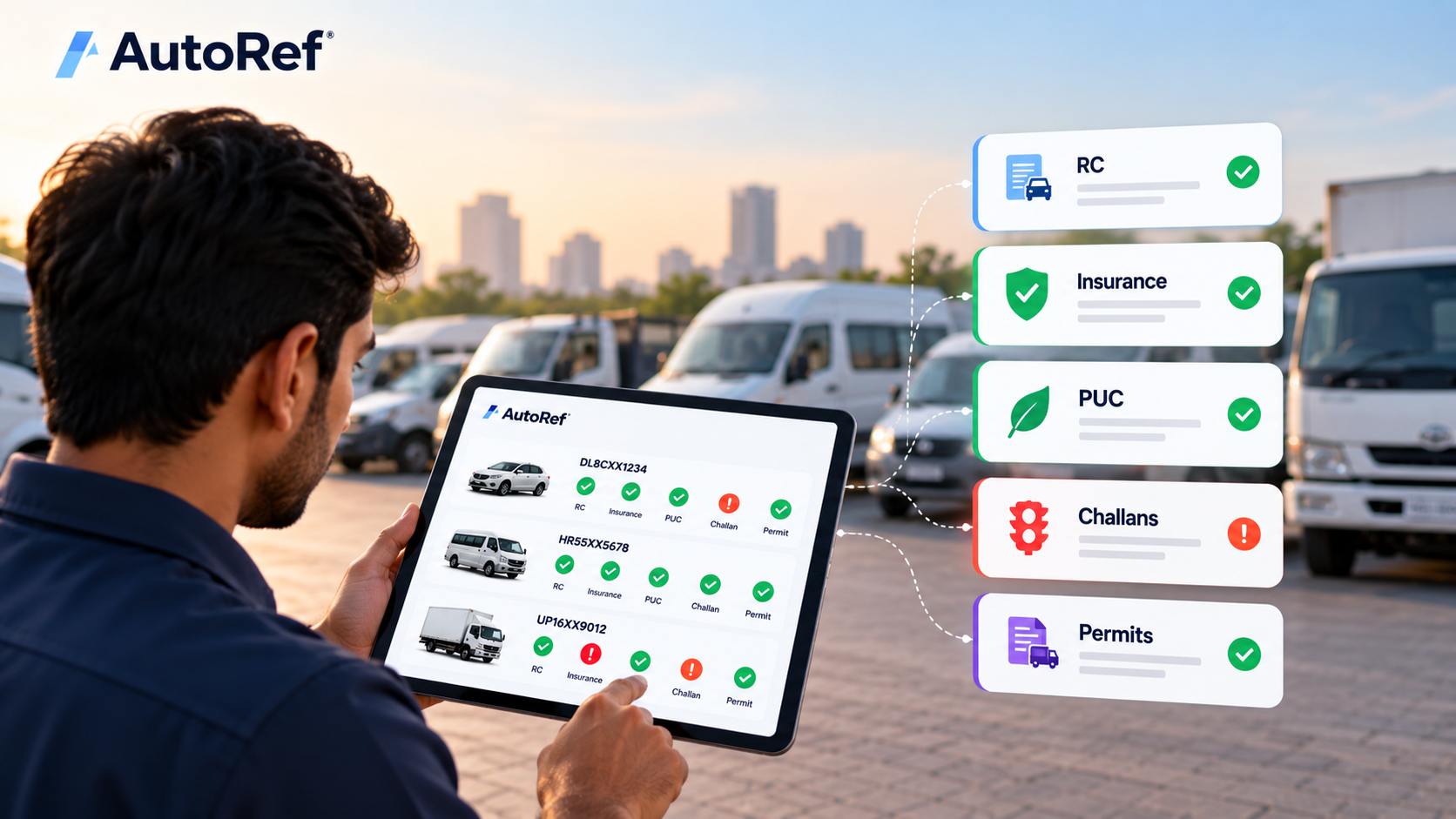
Managing a vehicle is not only about servicing it on time. RC, insurance, PUC, challans and permits all determine whether a vehicle can be legally operated and used without avoidable compliance problems.
This becomes more difficult for commercial operators because they may have several vehicles, different expiry dates and drivers who may not always report compliance issues promptly.
Vehicle Compliance Checklist: What You Need to Track
1. Registration Certificate (RC)
The RC establishes the vehicle's registration and ownership details. Owners should keep track of the registration validity and ensure that applicable renewal or related formalities are completed on time.
For commercial operators, an expired or problematic RC can disrupt operations and create additional enforcement risk.
2. Motor Insurance
Insurance protects the owner against specified financial liabilities arising from accidents and other covered events. Keeping the policy active is particularly important for commercial vehicles that operate frequently and spend more time on the road.
Owners should track the insurance expiry date rather than discovering that a vehicle's policy has lapsed when an incident occurs.
3. Pollution Under Control (PUC)
A valid PUC certificate confirms that the vehicle has been tested against applicable emission requirements. The validity period depends on the vehicle and applicable rules.
Commercial operators need to track PUC expiry across vehicles because allowing even one vehicle to operate without the required certificate can lead to enforcement issues.
4. Traffic Challans
Challans are often the easiest compliance item to overlook. A driver may receive a violation without the owner immediately knowing about it.
This creates a particular problem for fleets where different vehicles are driven by different people.
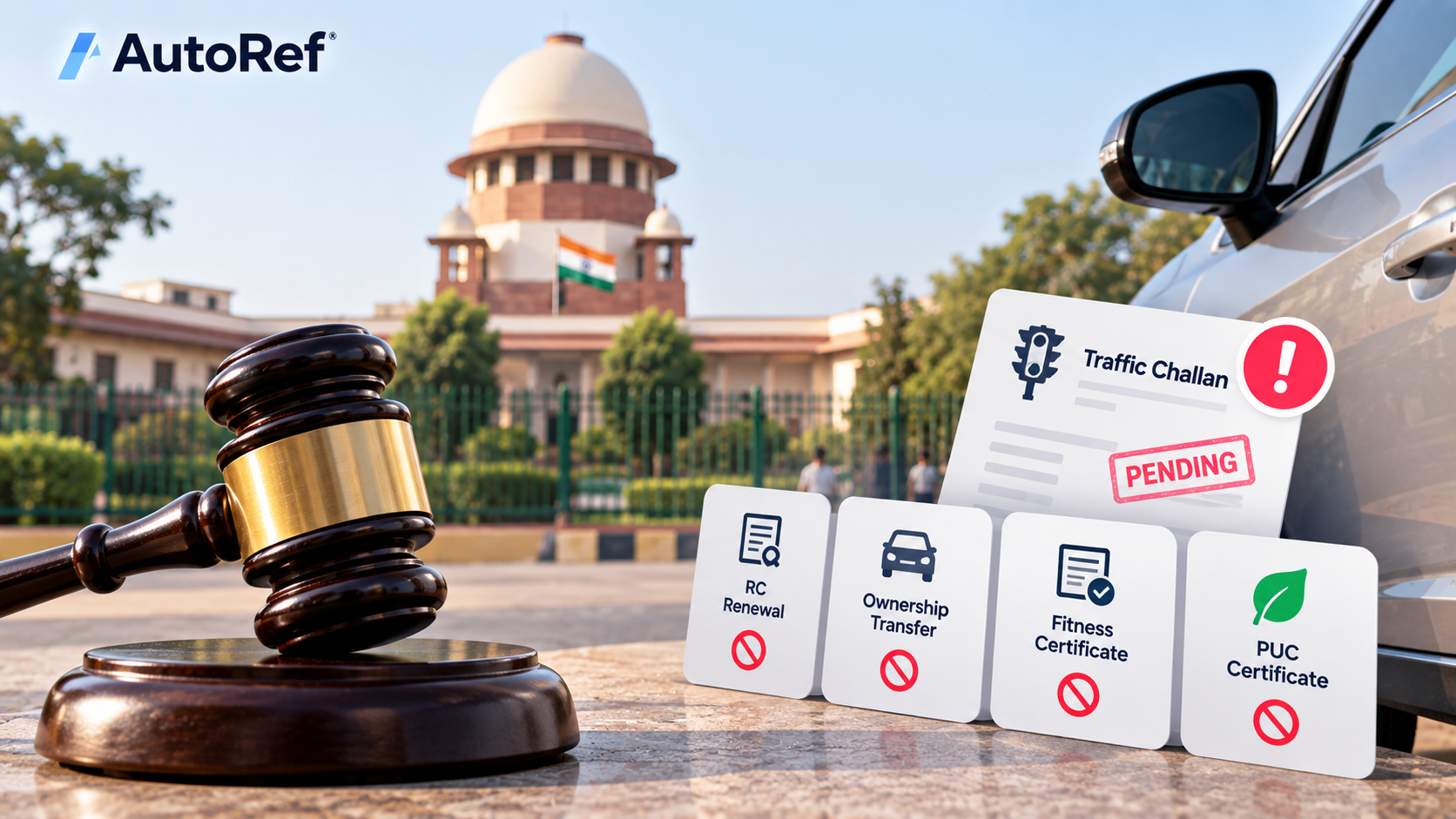
Pending fines can also become more significant than a simple payment obligation. In its September 28, 2026 order in S. Rajaseekaran v. Union of India, the Supreme Court directed stronger action over unpaid e-challans, including restrictions on specified vehicle-related services and blacklisting of vehicles with outstanding e-challans on the Parivahan portal.
5. Commercial Vehicle Permits
Commercial vehicles may require permits depending on the nature and area of operation. Permit validity, conditions and applicable requirements need to be tracked separately from the vehicle's RC and insurance.
A vehicle can therefore have valid insurance and PUC while still having a separate permit-related issue.
Why Compliance Is Difficult for Commercial Operators
The real problem is rarely the individual document. It is keeping all the documents updated for every vehicle.
A small operator managing 10 vehicles could have:
- - Vehicle 1: Insurance expiring this week
- - Vehicle 2: PUC already expired
- - Vehicle 3: Two pending challans
- - Vehicle 4: Permit renewal approaching
- - Vehicle 5: RC-related action required
When these details sit across WhatsApp messages, paper files, email attachments and separate government portals, something eventually gets missed.
Drivers can also create another information gap. A driver may receive a challan, forget to inform the owner, or assume that someone else in the organisation is handling it.
The Cost of Ignoring Vehicle Compliance
The cost is not limited to the original document renewal.
Missing or expired documents can result in traffic fines, penalties and enforcement action, while repeated or unresolved violations can create operational disruption.
For a commercial vehicle, even a relatively small fine can become expensive when combined with:
Penalty + vehicle downtime + lost trips + administrative effort
For example, if a vehicle is stopped because of a compliance issue and remains unavailable for several hours, the operator may lose revenue in addition to paying the applicable fine.
This is why compliance should be managed as an ongoing operational requirement rather than a once-a-year paperwork exercise.
How AutoRef Can Help
AutoRef brings RC, insurance, PUC, challans and permits together at the vehicle level, so owners can see the compliance status of each vehicle rather than maintaining separate lists for different documents. For commercial operators, this makes it easier to identify vehicles with pending challans, upcoming expiry dates or other compliance requirements and take action before they disrupt operations. Instead of checking several records manually, the owner gets a central view of what needs attention across the fleet.
A Simple Vehicle Compliance Checklist
For every vehicle, maintain:
| Compliance item | What to track |
|---|---|
| RC | Validity and registration details |
| Insurance | Policy number and expiry |
| PUC | Certificate validity and expiry |
| Challans | Pending and paid violations |
| Permit | Validity and applicable permit requirements |
The important part is not simply storing these details. It is knowing which vehicle needs attention and when.
Conclusion
Vehicle compliance is an ongoing responsibility covering much more than registration alone. RC, insurance, PUC, challans and permits each address a different requirement, and commercial operators have the added challenge of managing them across multiple vehicles.
Keeping these records together reduces the chances of missing an expiry, overlooking a challan or discovering a compliance problem only when the vehicle is stopped or a service is required.
Frequently Asked Questions
Can AutoRef track vehicle insurance expiry?
Yes. Insurance validity and expiry can be maintained against the relevant vehicle so upcoming renewals are easier to track.
Can AutoRef track pending challans?
Yes. Challan information can be maintained alongside the vehicle's other compliance records, helping operators identify vehicles that require attention.
Does AutoRef replace government portals for compliance checks?
No. Government systems remain the authoritative source for official status and transactions. AutoRef provides a central way to organise and track your vehicle compliance information.
Can AutoRef help small fleet owners manage compliance?
Yes. AutoRef is designed to manage information vehicle-by-vehicle, making it useful for operators who manage multiple cars or commercial vehicles.
Can AutoRef track all vehicle compliance details in one place?
AutoRef provides a vehicle-level view for tracking RC, insurance, PUC, challans and permits, helping owners keep different compliance requirements organised.
Related Articles
All Car Maintenance & Upkeep →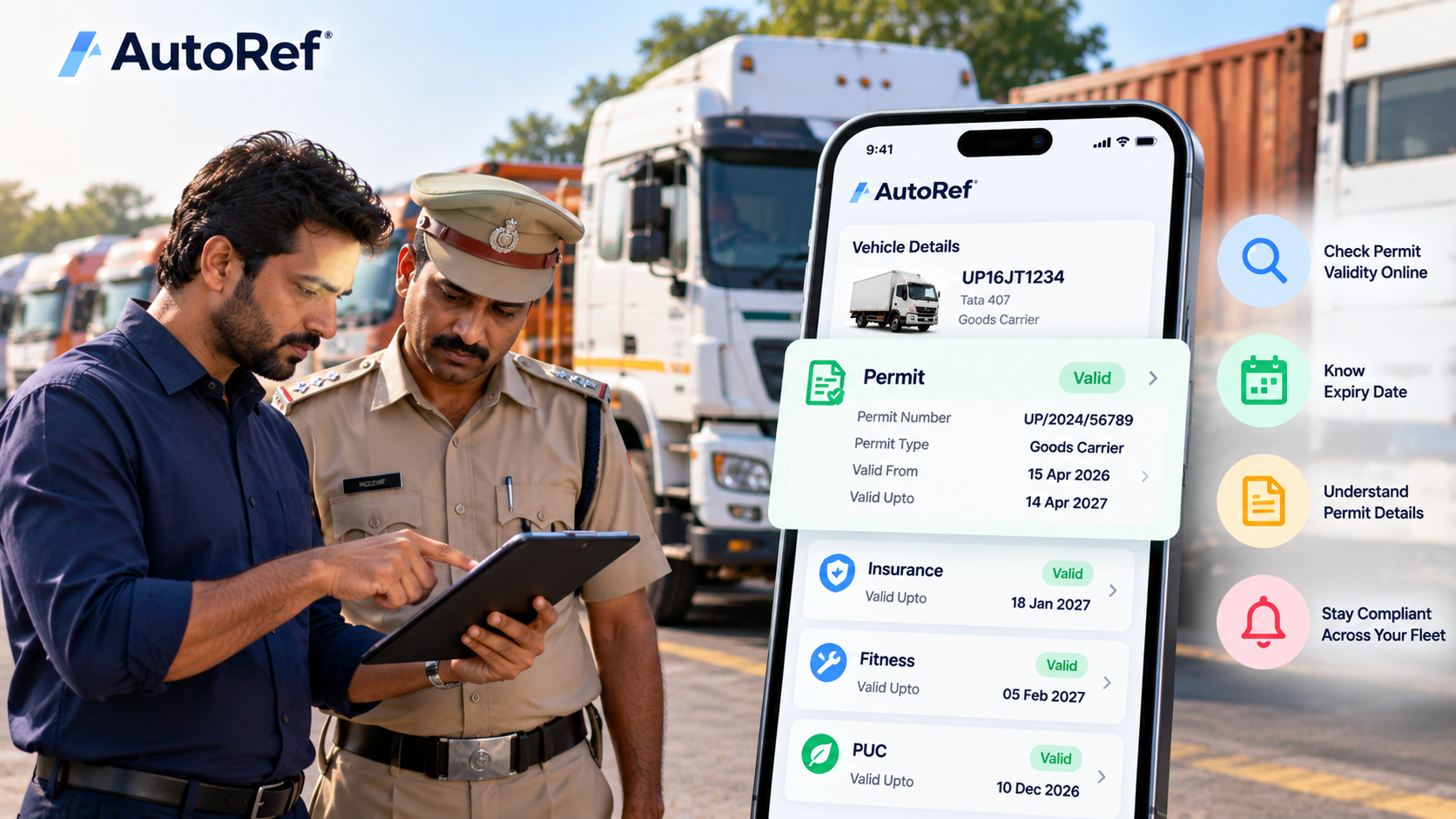 Car Maintenance & Upkeep
Commercial Vehicle Permit: How to Check Validity and Expiry
Commercial Vehicle Permit: Check Validity & Expiry
 Car Maintenance & Upkeep
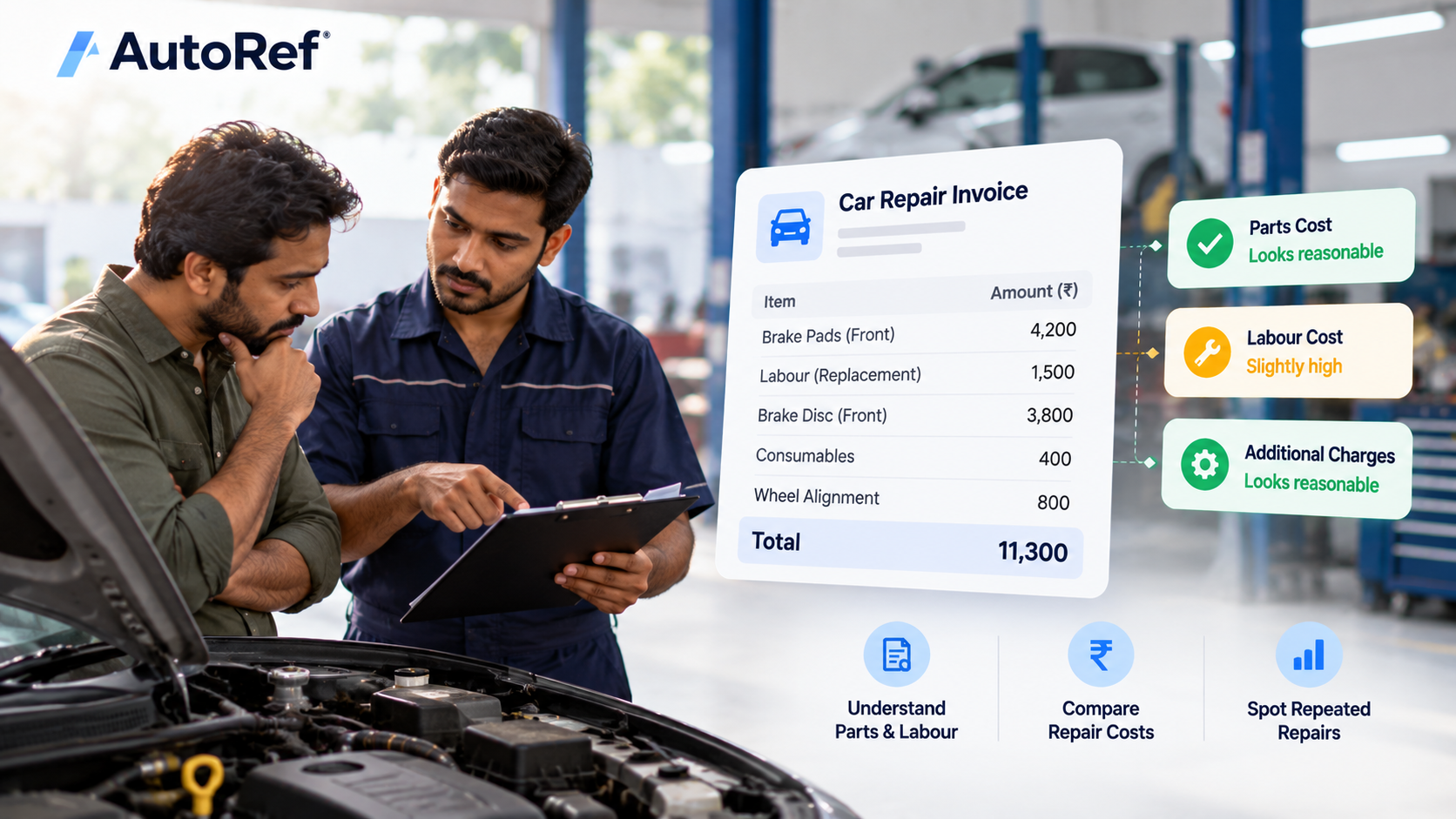
How to Check If a Car Repair Cost Is Reasonable
Learn how to check car repair costs, compare parts and labour, identify repeated repairs and evaluate repair bills for your car or fleet.
 Car Maintenance & Upkeep
Supreme Court on Unpaid Traffic Challans: What Vehicle Owners Need to Know
Supreme Court on Unpaid Traffic Challans: What Vehicle Owners Need to Know