
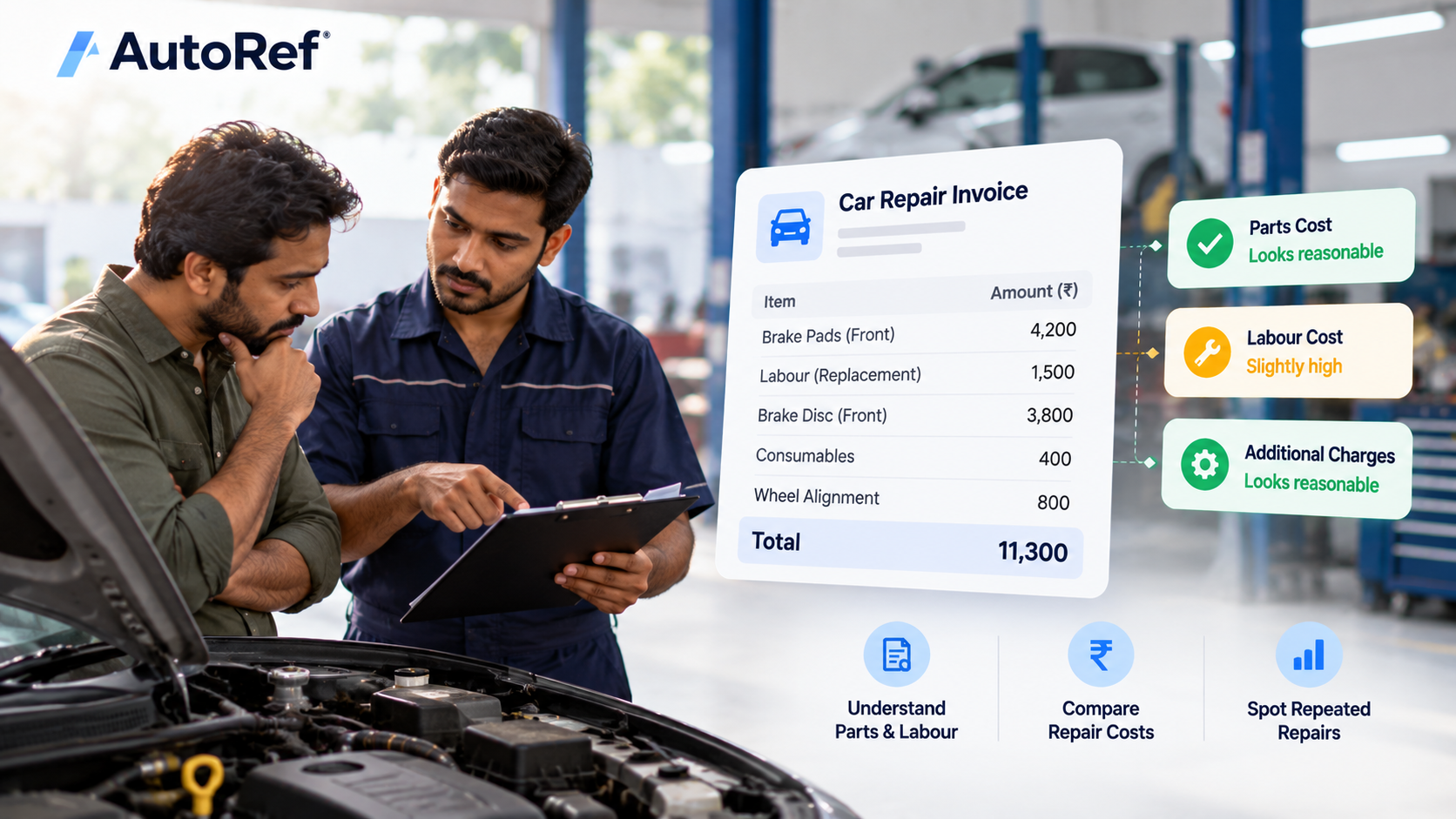
When a mechanic says “clutch problem,” “suspension issue,” “brake work,” or “injector cleaning,” many car owners know what the words mean but not what the repair should actually cost.
That creates an information gap. An owner may accept a ₹12,000 repair because they cannot tell whether the part was genuinely required, whether the labour is reasonable, or whether a cheaper repair was possible.
For fleet operators, the problem is different. When dozens of repairs are happening across different vehicles, drivers, garages and cities, even small differences in repair costs can become a significant operating expense.
The answer is not to assume that a low quote is good or a high quote is wrong. A reasonable repair cost depends on the vehicle, part, diagnosis, labour, location and actual condition.
What Makes a Car Repair Cost Reasonable?
A repair invoice generally contains four important components:
- 1. Parts – the component being repaired or replaced.
- 2. Labour – the work required to remove, repair and install it.
- 3. Diagnosis – inspection, scanning or testing used to identify the problem.
- 4. Consumables and additional work – fluids, cleaning, alignment and other associated operations.
The first question should therefore be:
What exactly is being repaired, and why does the vehicle need it?
For example, a brake-pad replacement should have evidence of wear. A suspension repair should identify the worn component rather than simply recommending replacement of the entire suspension assembly.
Manufacturer service information also distinguishes between inspection and replacement. Maruti's published maintenance schedules, for example, specify inspection of components such as brake pads, clutch operation and transmission oil rather than assuming every component needs replacement at a particular mileage.
Indicative Repair Costs in India
Actual prices vary by model, engine, part quality, city and workshop. As a rough planning reference for common passenger cars, owners may encounter ranges such as:
| Repair | Indicative parts + labour |
|---|---|
| Brake-pad replacement | ₹2,500–₹6,000 |
| Battery replacement | ₹4,000–₹8,000 |
| AC service | ₹1,500–₹4,000 |
| Clutch kit replacement | ₹6,000–₹15,000+ |
| Suspension-related repairs | ₹4,000–₹15,000+ |
| Wheel alignment & balancing | ₹800–₹2,000 |
| Major AC repair | ₹3,000–₹15,000+ |
These are indicative ranges, not standard market prices. Model-specific parts can vary considerably. For example, Maruti's own genuine-parts catalogue currently lists different brake-pad sets at prices ranging from a few hundred rupees to over ₹6,000, while clutch kits listed for different models range from around ₹2,000 to ₹6,800.
Maruti also provides a vehicle-specific service cost calculator because servicing costs depend on the model, mileage and current vehicle condition.
How Individual Car Owners Can Check a Repair Quote
You don't need to become a mechanic to ask better questions.
Ask what failed
Instead of asking only “How much will it cost?”, ask:
What component has failed, what evidence shows it has failed, and what happens if I don't replace it now?
Separate replacement from repair
A worn suspension bush may not necessarily mean replacing every suspension component.
Similarly, a battery that is old does not automatically mean it has failed. A diagnostic or battery-health test can provide additional evidence.
Check parts and labour separately
A ₹10,000 invoice becomes much easier to evaluate when you know whether it contains:
- - ₹7,000 in parts
- - ₹2,000 labour
- - ₹1,000 consumables
rather than seeing only a ₹10,000 total.
Check your previous repairs
A component replaced recently deserves a closer look if the same repair is recommended again.
Your vehicle maintenance records can therefore be as valuable as the current quotation.
Why Repair Cost Tracking Matters for Fleet Operators
For a large fleet, the question is not simply:
“Is this ₹8,000 repair reasonable?”
It is:
“Why are we spending ₹8,000 on this type of repair when another vehicle costs ₹5,000?”
Fleet operators should compare repair expenditure by:
- - Vehicle
- - Driver
- - Garage/workshop
- - City
- - Repair category
- - Part
- - Frequency
- - Cost per repair
For example:
| Vehicle | Garage | Repair | Cost |
|---|---|---|---|
| Taxi 01 | Garage A | Brake repair | ₹4,800 |
| Taxi 02 | Garage A | Brake repair | ₹5,100 |
| Taxi 03 | Garage B | Brake repair | ₹3,600 |
| Taxi 04 | Garage A | Brake repair | ₹7,900 |
The ₹7,900 invoice does not automatically mean overcharging. The vehicle could have required additional parts. But it creates a variance worth investigating.
Repeated repairs are another important signal. If the same vehicle repeatedly incurs suspension or cooling-system repairs, the operator should investigate whether the underlying problem is being properly resolved.
How AutoRef Helps
AutoRef brings repair invoices together with historical vehicle service data. Owners can upload invoices and review the parts, labour and additional charges, while previous service records provide context about what was repaired earlier. For fleet operators, this creates a basis for comparing repair costs across vehicles and identifying repeated work or unusual spending patterns by garage, driver or location. AutoRef does not treat a higher charge as automatically incorrect; instead, it helps surface items that deserve closer review and gives the owner better information before approving repairs.
A Simple Repair Cost Check
Before approving an expensive repair, check:
Diagnosis → Part → Quantity → Part price → Labour → Previous repair → Final invoice
If one of these is unclear, ask the workshop for an explanation.
For fleets, add:
Vehicle → Driver → Garage → City → Repair frequency → Cost
This turns individual repair bills into useful operating data.
Conclusion
There is no single price that makes a car repair “reasonable.” A ₹5,000 repair can be expensive if the work was unnecessary, while a ₹15,000 repair can be justified if it involves the correct parts and labour for a genuine problem.
For individual owners, the biggest challenge is often lack of technical knowledge and confidence when discussing repairs. For fleet operators, the challenge is seeing patterns across hundreds of repair transactions.
Keeping invoices and historical service information together helps both groups move from simply accepting repair bills to asking better questions about what they are paying for.
Frequently Asked Questions
Can AutoRef help me check whether a car repair bill is reasonable?
AutoRef analyses uploaded service and repair invoices and can highlight parts, labour and other charges that may require confirmation or justification.
Can AutoRef compare a repair with my vehicle's previous repairs?
Yes. Historical service data provides context about previous repairs, helping you identify repeated work or recently replaced components.
Can fleet operators compare repair costs across garages?
AutoRef can organise repair information at the vehicle level, helping fleet operators use historical invoice data to identify cost differences and recurring repairs across their vehicles.
Does AutoRef decide that a garage has overcharged me?
No. A higher charge does not automatically mean overcharging. AutoRef helps identify charges that may need further review based on the available invoice and vehicle context.
Can I upload old repair invoices to AutoRef?
Historical invoices can be used to build the vehicle's service and repair record, giving you more context when evaluating future repairs.
Related Articles
All Car Maintenance & Upkeep → Car Maintenance & Upkeep
Commercial Vehicle Permit: How to Check Validity and Expiry
Commercial Vehicle Permit: Check Validity & Expiry
 Car Maintenance & Upkeep
Vehicle Compliance Checklist: RC, Insurance, PUC, Challans and Permits
Vehicle compliance checklist covering RC, insurance, PUC, challans and permits, with practical tips for individual owners and commercial fleets.
 Car Maintenance & Upkeep
Supreme Court on Unpaid Traffic Challans: What Vehicle Owners Need to Know
Supreme Court on Unpaid Traffic Challans: What Vehicle Owners Need to Know