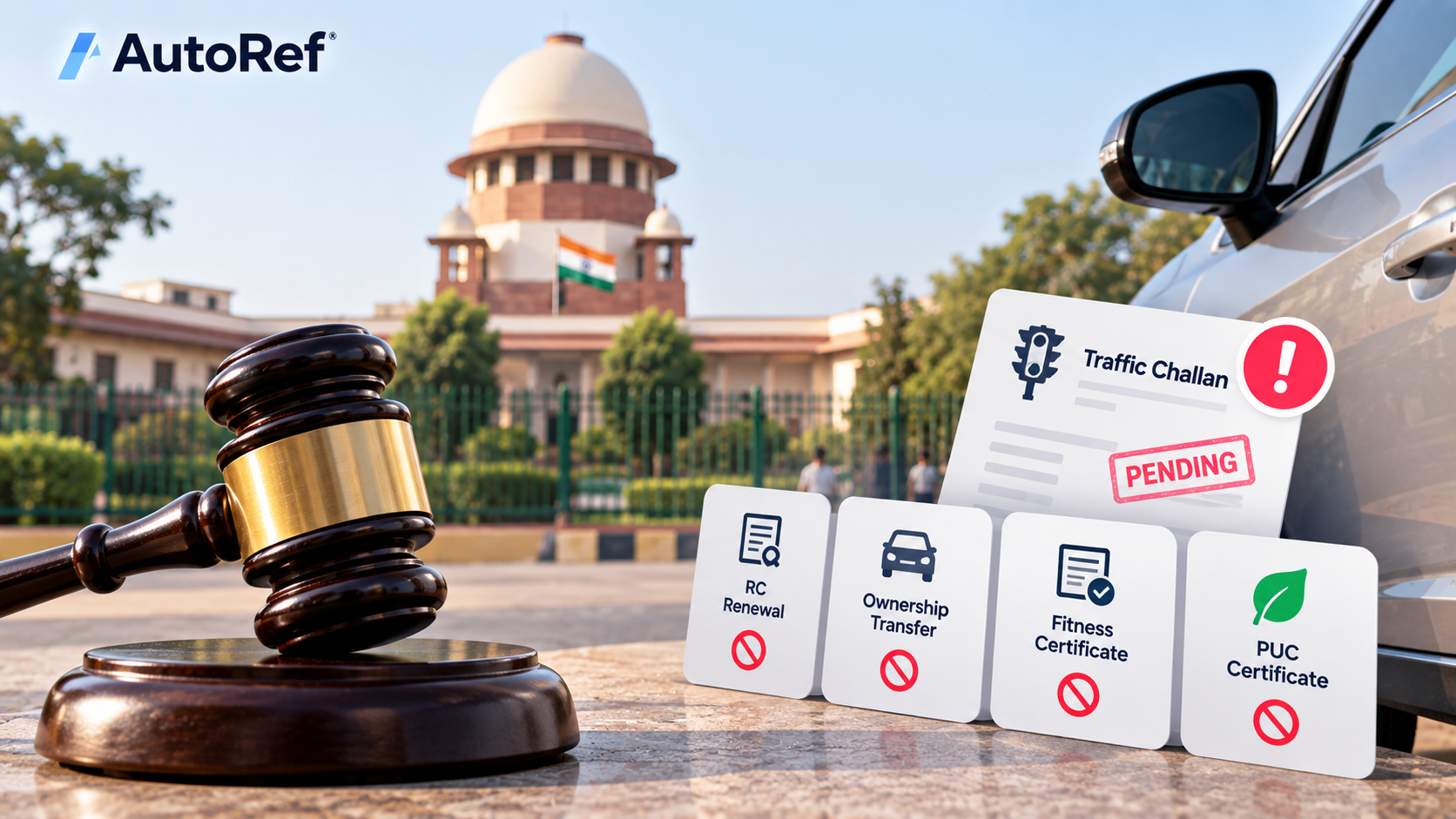
A traffic challan that remains unpaid may no longer be something a vehicle owner can simply deal with later.
In an order dated September 28, 2026, in S. Rajaseekaran v. Union of India, the Supreme Court directed States and Union Territories to take stronger steps to recover outstanding e-challan amounts. The order includes restrictions on several vehicle-related services, blacklisting of vehicles on the Parivahan portal and enforcement action against vehicles with unpaid challans.
The development is particularly relevant for people managing multiple vehicles, where individual challans can easily get overlooked.
What Did the Supreme Court Direct?
The Court was informed that approximately ₹49,194.05 crore remained recoverable against e-challans issued over time, while about ₹26,175.05 crore had been recovered. The Court emphasised that issuing e-challans is not enough if authorities cannot effectively recover the fines.
The directions include:
- - Restricting renewal of a vehicle's registration where outstanding traffic fines remain.
- - Not issuing duplicate registration certificates until dues are cleared.
- - Not processing certain requests to update the owner's address.
- - Withholding fitness certificates where pending fines remain.
- - Blacklisting vehicles with outstanding e-challans on the Parivahan portal.
- - Preventing ownership transfer of such vehicles.
- - Not permitting PUC centres to issue pollution certificates until outstanding dues are cleared.
- - Taking action on driving-licence renewal in cases involving multiple violations.
- - Conducting random vehicle checks and taking necessary steps to impound vehicles found with unpaid e-challans.
These directions are part of the Court's continuing monitoring of road-safety enforcement in the case, which has been before the Court since 2012.
What Does This Mean for Vehicle Owners?
The important change is that an unpaid challan can potentially affect other vehicle-related services, rather than remaining only a monetary liability.
For example, an owner who has ignored an outstanding e-challan may later discover that the vehicle faces difficulty with:
| Vehicle activity | Potential impact of outstanding fines |
|---|---|
| Registration renewal | May be restricted |
| Duplicate RC | May be withheld |
| Ownership transfer | May be blocked |
| Fitness certificate | May not be issued |
| PUC certificate | May not be issued |
| Vehicle sale | Blacklisting can affect transfer |
| Driving licence renewal | Action directed in cases involving multiple violations |
| Enforcement checking | Vehicle may face impounding |
The exact implementation will depend on how States and UTs operationalise the Court's directions and the relevant systems.
Why This Matters for Cars With Multiple Challans
The problem becomes more significant when a vehicle has accumulated several violations.
The Court also referred to Rule 21(25) of the Central Motor Vehicles Rules, in its amended form, under which five or more offences or contraventions under the Motor Vehicles Act or Rules within a one-year period beginning January 1, 2026, constitute conduct treated as nuisance or danger to the public. The order links this broader enforcement context with action concerning driving licences for multiple violations.
This means vehicle owners should not look at every challan as an isolated event. A history of repeated violations can create a different compliance situation from a single unpaid fine.
Why This Is a Bigger Problem for Small Fleets
For an individual car owner, checking one vehicle periodically is relatively straightforward.
For a small fleet owner managing 5, 10 or 20 vehicles, it is different.
One vehicle may have:
- - Two pending challans
- - Another vehicle may have a PUC nearing expiry
- - Another may have an insurance renewal approaching
- - A fourth vehicle may have several historical traffic violations
If these records are maintained separately, it becomes difficult to know which vehicle needs attention first.
This is especially relevant for taxi operators, commercial vehicle owners and people who have vehicles driven by employees, family members or hired drivers.
What Should Vehicle Owners Do Now?
1. Check your pending challans
Use the official e-challan/Parivahan system to check whether any challans are outstanding against your vehicle.
2. Verify the details
Before making a payment, check the registration number, challan details, date, offence and amount.
3. Clear legitimate outstanding fines
Keep the payment confirmation or receipt after completing the transaction.
4. Check other compliance requirements
Don't look at challans in isolation. Also check:
- RC validity
- Insurance expiry
- PUC validity
- Fitness certificate, where applicable
- Permit validity for commercial vehicles
5. Keep a vehicle-wise record
For multiple vehicles, maintain compliance information against each individual vehicle rather than keeping one general list.
Don't Confuse the Supreme Court's Directions With Every Reported Proposal
There has also been reporting about the possibility of recovering unpaid traffic fines through electricity bills.
That should not be presented as part of the Court's written directions. The written order focuses on vehicle-related services, blacklisting, PUC and fitness restrictions, licence-related action in cases involving multiple violations, and enforcement including vehicle impounding. The electricity-bill idea was discussed during proceedings but was not included in the September 28 written order.
This distinction matters when explaining the development to vehicle owners.
How AutoRef Can Help
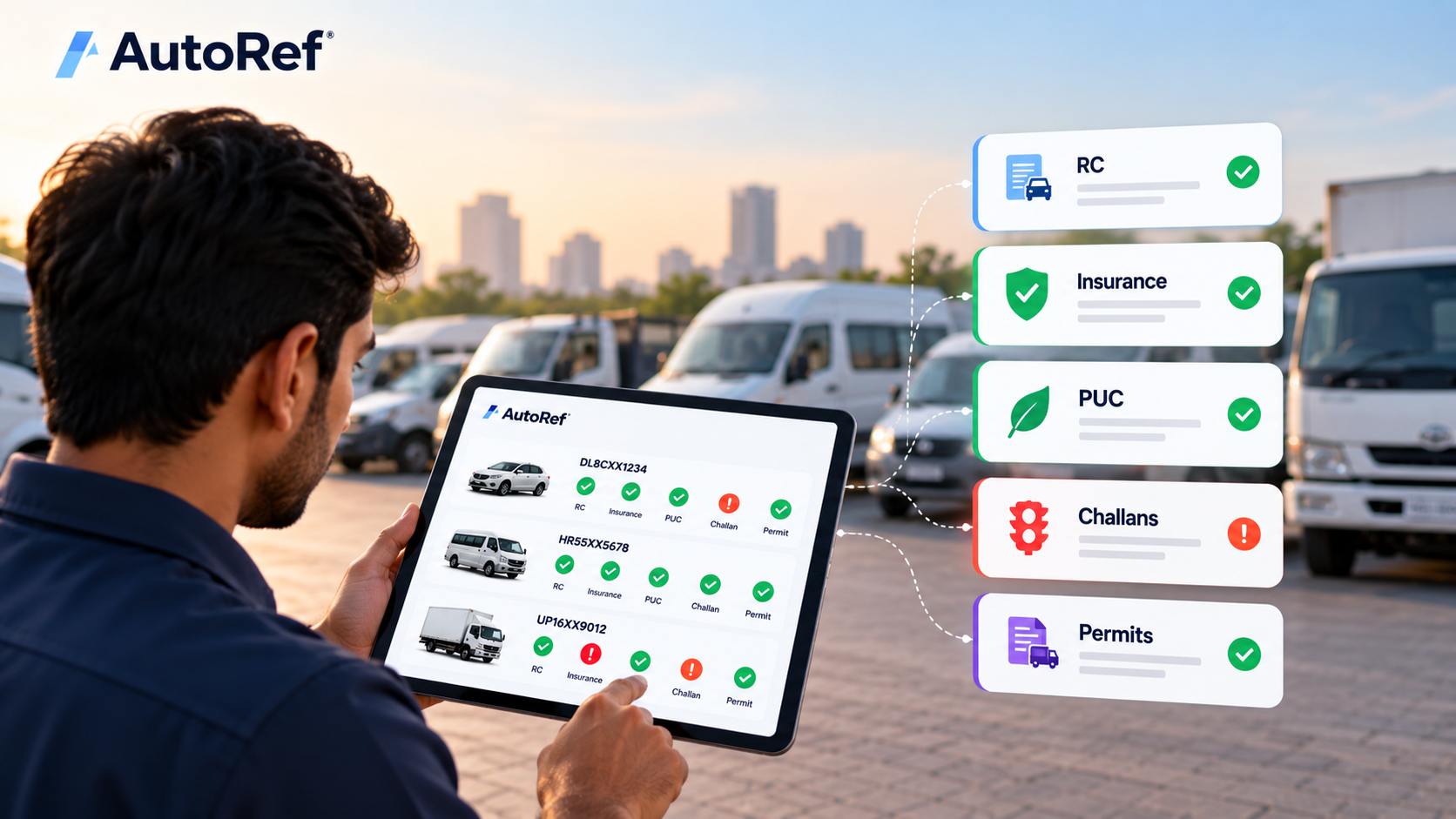
AutoRef helps vehicle owners keep challans, RC, insurance, PUC and permits organised against each vehicle. Instead of relying on scattered records, owners and small fleet operators can use a vehicle-wise compliance view to identify pending issues and upcoming expiry dates. This becomes particularly useful when several vehicles have different challans and compliance requirements, helping you know which vehicle needs attention before an outstanding issue affects a future vehicle-related transaction.
Conclusion
The Supreme Court's latest directions make unpaid traffic challans more important to track than before. The issue is no longer simply about remembering to pay a fine; outstanding e-challans can potentially affect vehicle-related services such as registration, ownership transfer, fitness and PUC, while multiple violations can have consequences for driving-licence renewal.
For individual owners, regularly checking pending challans can prevent unpleasant surprises. For small fleet operators, maintaining a vehicle-wise compliance record becomes even more important because different vehicles can have different outstanding fines and expiry dates.
Frequently Asked Questions
Can AutoRef track pending challans for my vehicle?
AutoRef provides a vehicle-level compliance view where challans can be tracked alongside RC, insurance, PUC and other vehicle compliance information.
Can AutoRef manage challans for multiple vehicles?
Yes. AutoRef is designed to maintain compliance information at the individual vehicle level, which can be useful for small fleet owners managing several vehicles.
Can AutoRef track PUC and insurance along with challans?
Yes. Vehicle compliance information can be managed together so owners can see challans, PUC, insurance, RC and applicable permit information for each vehicle.
Does AutoRef pay my traffic challan?
AutoRef's role is to help you identify and track vehicle compliance requirements. Payment of a challan should be completed through the appropriate official government channel.
How can I check whether my vehicle has an unpaid challan?
You can check pending e-challans through the official e-challan/Parivahan system using the available vehicle, challan or driving-licence details.
Related Articles
All Car Maintenance & Upkeep →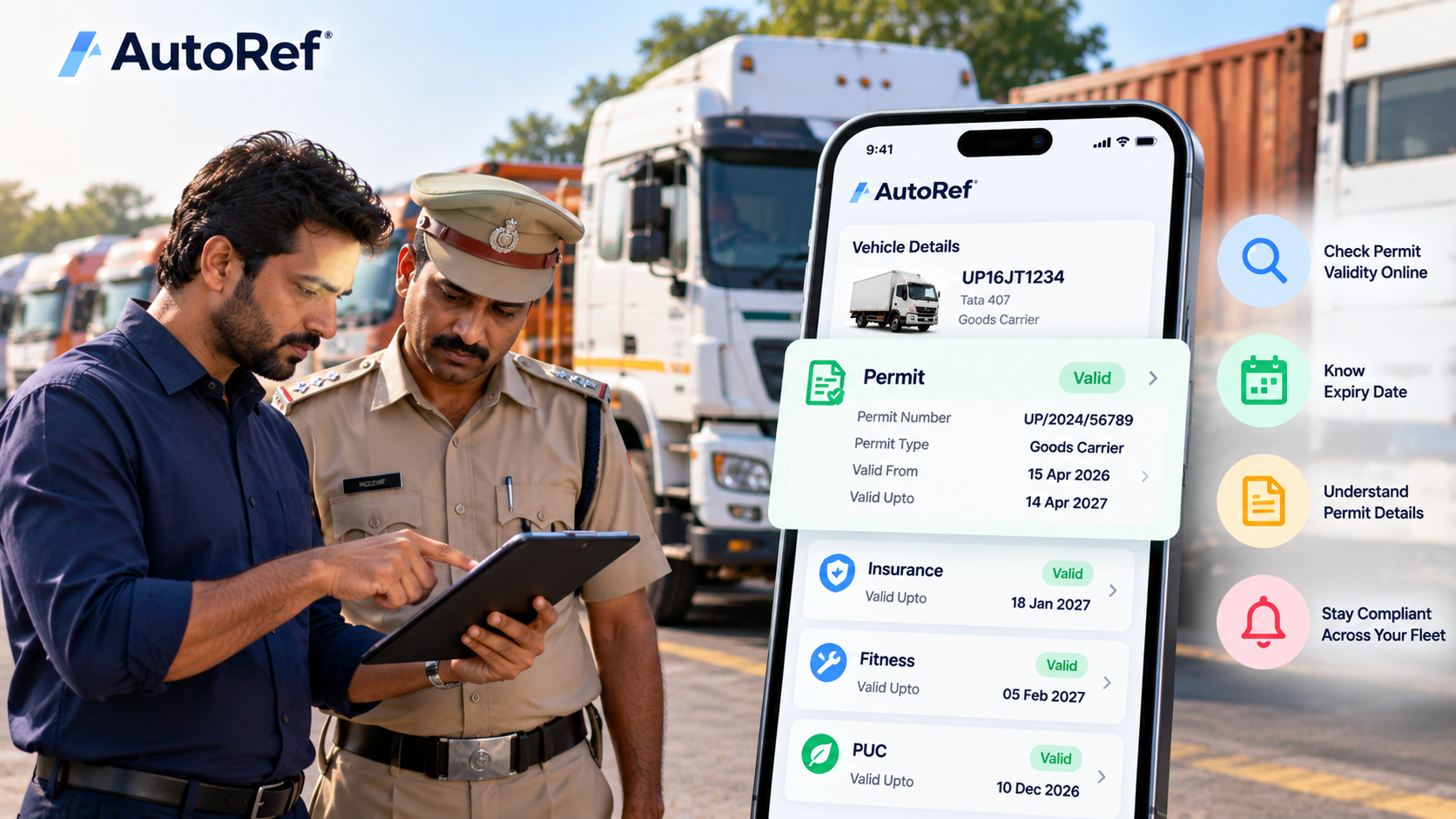 Car Maintenance & Upkeep
Commercial Vehicle Permit: How to Check Validity and Expiry
Commercial Vehicle Permit: Check Validity & Expiry
 Car Maintenance & Upkeep
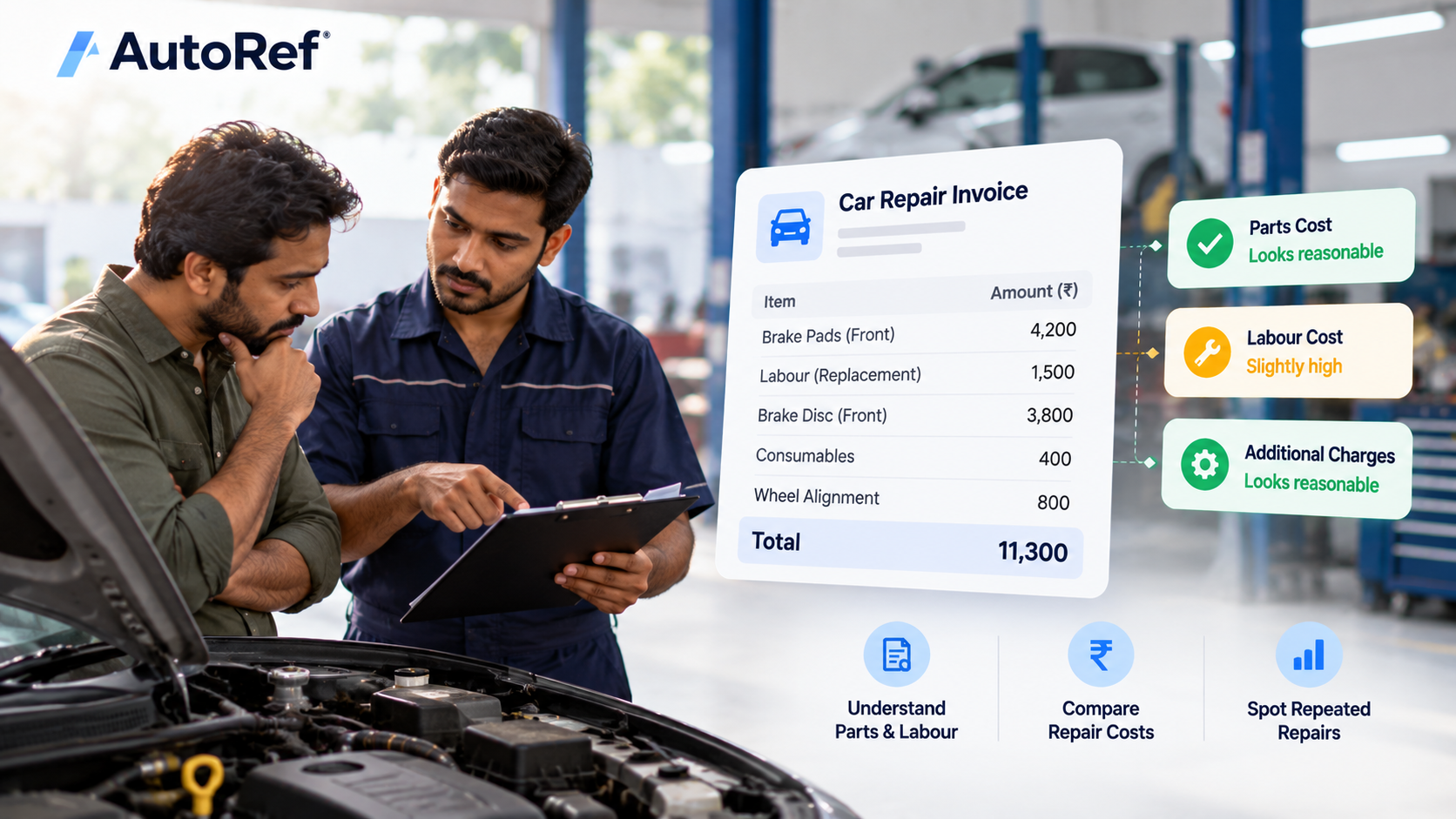
How to Check If a Car Repair Cost Is Reasonable
Learn how to check car repair costs, compare parts and labour, identify repeated repairs and evaluate repair bills for your car or fleet.
 Car Maintenance & Upkeep
Vehicle Compliance Checklist: RC, Insurance, PUC, Challans and Permits
Vehicle compliance checklist covering RC, insurance, PUC, challans and permits, with practical tips for individual owners and commercial fleets.