
Introduction
A preventive maintenance program is designed to reduce unexpected breakdowns, control maintenance costs, and keep vehicles available for operations. But simply creating a maintenance schedule does not guarantee that the program will work.
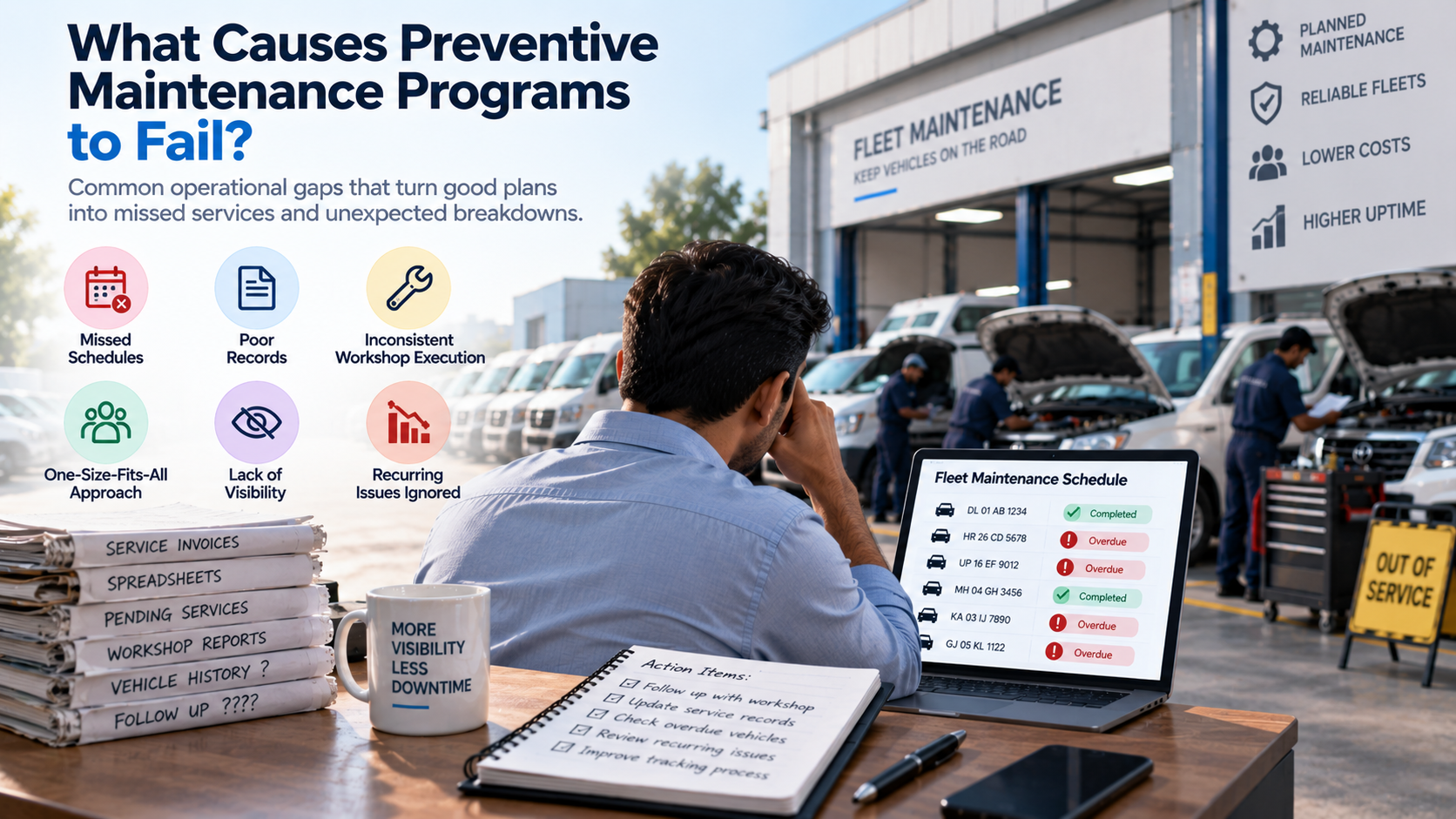
Fleet maintenance often breaks down because the process between planning, execution, recording, and review is inconsistent.
Schedules get missed, vehicle records become incomplete, workshops follow different processes, and recurring problems are not identified. Over time, what was intended to be preventive maintenance becomes reactive maintenance with additional administrative work.
Understanding these failure points is the first step toward building a more reliable maintenance process.
1. Missed Maintenance Schedules
One of the simplest reasons preventive maintenance programs fail is that scheduled work is not completed on time.
A vehicle may reach its service interval while still being used because taking it off the road would affect operations. Without clear visibility of upcoming requirements, maintenance gets postponed until the vehicle becomes unavailable or develops a problem.
A preventive maintenance schedule needs both a defined trigger and a process for ensuring the work actually happens.
2. Using the Same Schedule for Every Vehicle
Fleet vehicles do not necessarily experience the same level of wear.
A high-mileage taxi, a frequently rented vehicle, and an occasionally used corporate vehicle can have very different maintenance requirements.
Applying identical service intervals without considering mileage, utilisation, operating conditions, and vehicle condition can result in maintenance being performed too early on some vehicles and too late on others.
3. Poor or Incomplete Maintenance Records
A preventive maintenance program depends on knowing what has already happened to each vehicle.
If service records are incomplete, fleet managers may not know when a component was replaced, whether a repair was repeated, or how much maintenance a vehicle has required over time.
Without reliable vehicle maintenance history, future maintenance decisions are based on assumptions rather than evidence.
4. Inconsistent Workshop Execution
Even when maintenance is scheduled correctly, the quality and consistency of execution can vary between workshops or service providers.
Different providers may record work differently, use different descriptions for similar repairs, or provide incomplete information about parts and labour.
Fleet operators therefore need a consistent process for recording what work was actually performed.
5. Focusing Only on Scheduled Servicing
Preventive maintenance is broader than periodic servicing.
Inspections, tyre condition, battery health, recurring faults, component replacement patterns, and driver-reported issues can all provide early warning signs.
A program that only tracks the next service date can miss important indicators that a vehicle requires attention sooner.
6. Failing to Learn From Previous Repairs
Maintenance history becomes valuable when it influences future decisions.
If a vehicle repeatedly develops the same problem but each repair is treated as an isolated event, the underlying pattern can remain hidden.
Fleet operators should periodically review maintenance records to identify repeat repairs, frequently replaced components, and vehicles requiring unusually high levels of maintenance.
7. Lack of Visibility Across the Fleet
As fleets grow, maintenance information can become fragmented across spreadsheets, invoices, workshop records, and messages.
Fleet managers then spend time searching for information instead of using it to make decisions.
A centralized system can provide better maintenance visibility by connecting service and repair information to individual vehicles.
AutoRef helps fleet owners maintain vehicle-level service and repair records, making it easier to understand what has happened to each vehicle and use that history when planning future maintenance.
How to Improve a Failing Maintenance Program
A stronger process should connect four stages:
Plan → Execute → Record → Review
Create maintenance triggers, ensure work is completed, record the outcome against the vehicle, and periodically review the history for recurring patterns.
Preventive maintenance becomes effective when these four stages operate as one continuous process rather than as separate administrative tasks.
Conclusion
Preventive maintenance programs rarely fail because fleet owners do not understand the importance of servicing vehicles. They fail because the process is difficult to execute consistently as the fleet grows.
Missed schedules, generic maintenance intervals, incomplete records, inconsistent workshop execution, and failure to learn from previous repairs can all undermine the program.
Improving visibility and maintaining accurate vehicle-level history can help fleet operators turn preventive maintenance from a calendar of tasks into a continuous process for managing vehicle reliability.
Frequently Asked Questions
Why do preventive maintenance programs fail?
Common causes include missed maintenance schedules, incomplete records, inconsistent workshop execution, applying identical schedules to different vehicles, and failing to review previous maintenance.
How can fleet operators improve preventive maintenance?
They should combine appropriate maintenance triggers with consistent scheduling, accurate vehicle-level records, regular inspections, and periodic reviews of maintenance history.
Does preventive maintenance eliminate unexpected breakdowns?
No. Preventive maintenance can reduce avoidable failures but cannot eliminate unexpected breakdowns, accidents, or sudden component failures.
Related Articles
All Fleet Maintenance Management → Fleet Maintenance Management
10 Essential Tasks for a Fleet Preventive Maintenance Checklist
Use this fleet preventive maintenance checklist to track 10 essential tasks covering tyres, fluids, brakes, batteries, servicing, and vehicle history.
 Fleet Maintenance Management
How Often Should Fleet Vehicles Be Serviced?
Set fleet service intervals using mileage, usage, conditions, age and repair history not just the calendar. Build schedules per vehicle for reliability.
 Fleet Maintenance Management
Preventive vs Reactive Maintenance: Which Approach Works Better for Fleets?
Compare preventive vs reactive maintenance and understand how each approach affects fleet costs, downtime, vehicle availability, and operations.