
Introduction
A car repair invoice can include much more than the cost of the part that was replaced. You may see labour charges, engine oil, filters, consumables, taxes, wheel alignment, and additional repairs identified during servicing. If you approve the total without checking these details, you could miss billing errors, unapproved work, or warranty coverage that may reduce your expense.
For example, imagine your car has driven 42,000 km and the workshop gives you a final bill of ₹12,400. The original estimate was ₹8,500. The additional ₹3,900 might be justified by a worn brake component or another necessary repair, but you should verify what changed, why it was required, and whether you approved it.
Analysing a car repair bill does not mean assuming the garage has overcharged you. It means understanding what you are paying for before you make the payment.
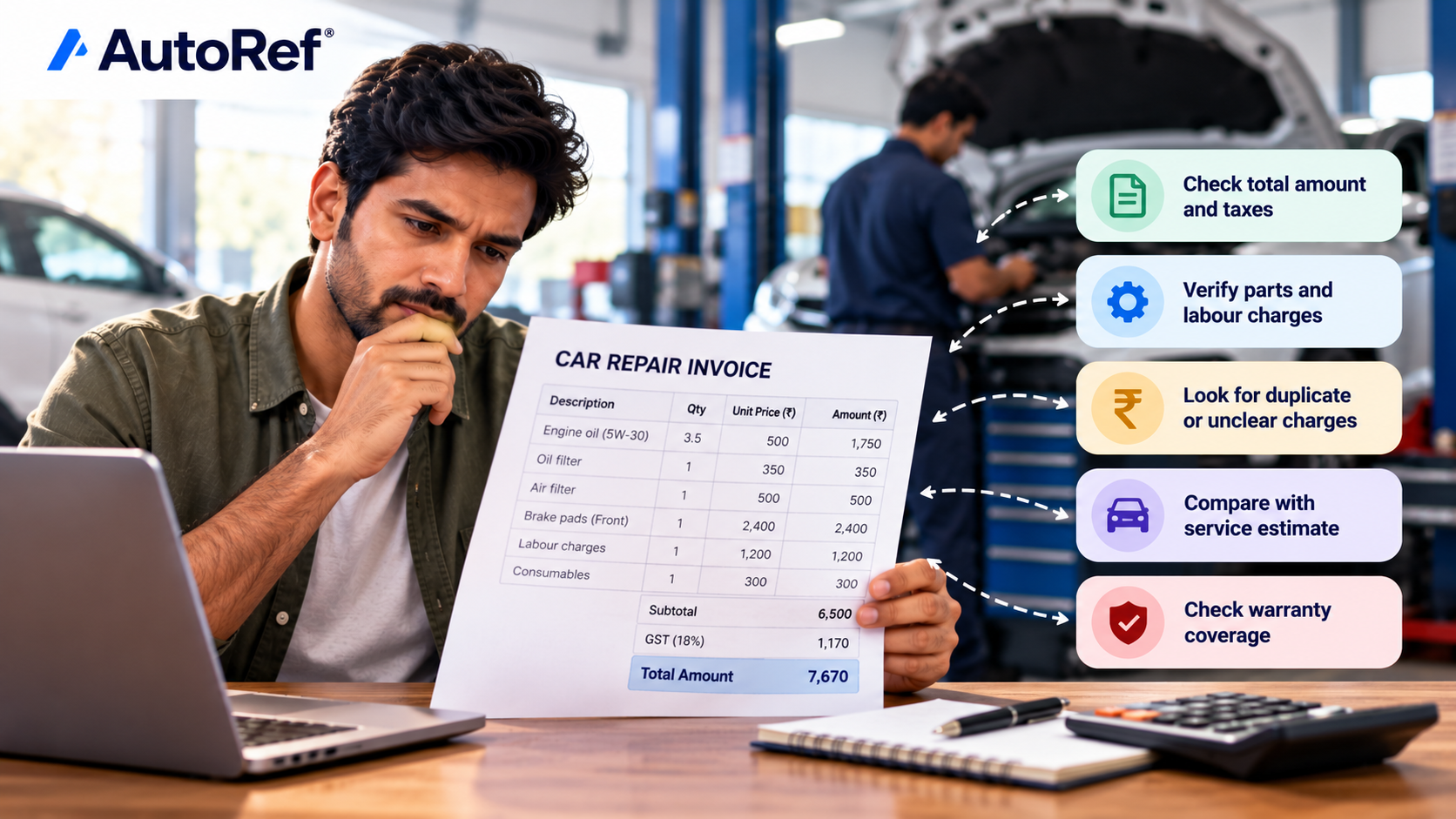
1. Check the total amount, taxes, and payment details
Start with the invoice summary. Verify the subtotal, discounts, taxes, advance payment, and final amount due.
For example:
| Invoice item | Illustrative amount |
|---|---|
| Parts and fluids | ₹4,200 |
| Labour | ₹1,800 |
| Other consumables | ₹300 |
| Subtotal | ₹6,300 |
| GST, if applicable | ₹1,134 |
| Total payable | ₹7,434 |
These are sample figures, not a standard price for every car. Actual prices depend on the vehicle, parts, workshop, and applicable taxes.
Check that the final amount matches the invoice and that any advance payment or discount has been accounted for. If the estimate was ₹6,500 but the final invoice is ₹7,434, ask the workshop to explain the difference before paying.
2. Verify every part and labour charge
Read the line items instead of checking only the grand total. Each replacement should have a clear description, quantity, and price. Labour should also be identifiable.
Suppose a workshop invoice contains the following:
| Item | Quantity | Amount |
|---|---|---|
| Engine oil | 3.5 litres | ₹1,750 |
| Oil filter | 1 | ₹350 |
| Air filter | 1 | ₹500 |
| General service labour | 1 | ₹1,200 |
| Subtotal | ₹3,800 |
Ask whether the oil quantity matches the manufacturer's specification for your model and engine. Check whether the filters were actually replaced and whether the labour description matches the work performed.
If a line says “general repairs - ₹2,000” without explaining the work, request an itemised breakdown. A vague description is a reason to ask for clarification, not proof that the charge is incorrect.
3. Look for duplicate, unclear, or unexpected charges
Some invoice items deserve closer inspection because their descriptions overlap or their purpose is unclear.
For example, an invoice might list both “periodic service labour - ₹1,500” and “engine oil replacement labour - ₹450.” These could represent separate work, or the second charge could already be included in the first. Ask the workshop to explain the difference.
Also check for:
- Parts listed more than once.
- Consumables without a clear description.
- Repairs that were not included in the estimate.
- Quantities that seem inconsistent with the work performed.
- Discounts mentioned in the estimate but missing from the final invoice.
- Compare the bill with the job card, estimate, and messages approving additional work. If you did not approve an extra repair, ask when and how the approval was recorded.
4. Compare free and paid services at every 10,000 km
A car's service requirements depend on its make, model, engine, age, usage, and manufacturer's maintenance schedule. Many workshops use 10,000 km intervals as a convenient reference, but this is not a universal rule. Some vehicles require servicing sooner, and time-based servicing may apply even when the car has not covered the expected distance.
The table below gives an illustrative example of what a petrol car's service history and invoice might look like. It is not a manufacturer-approved schedule or a promise that a particular service will be free.
| Odometer reading | Service type in this example | Illustrative work | Sample invoice range |
|---|---|---|---|
| 10,000 km | Free/complimentary, if eligible | Inspection, fluid checks, scheduled adjustments | ₹0-₹2,000 |
| 20,000 km | Paid periodic service | Engine oil, oil filter, inspections, labour | ₹4,000-₹7,000 |
| 30,000 km | Paid periodic service | Oil and filter, air filter if due, inspections | ₹4,500-₹8,000 |
| 40,000 km | Paid periodic service | Scheduled fluids or filters, broader checks | ₹5,000-₹10,000 |
| 50,000 km | Paid periodic service | Routine service plus any due replacements | ₹4,500-₹9,000 |
| 60,000 km | Paid periodic service | Scheduled maintenance, possible fluid changes | ₹6,000-₹12,000 |
| 70,000 km | Paid periodic service | Routine service and condition-based repairs | ₹4,500-₹10,000 |
| 80,000 km | Paid periodic service | Routine work and any model-specific replacements | ₹6,000-₹15,000 |
| 90,000 km | Paid periodic service | Oil and filter, inspections, condition-based work | ₹4,500-₹10,000 |
| 1,00,000 km | Paid periodic service | Scheduled maintenance and assessment of wear items | ₹8,000-₹20,000+ |
Important: These are broad, illustrative ranges for a typical small petrol car in India, not verified current prices or fixed service-package rates. Premium cars, diesel vehicles, automatic transmissions, expensive fluids, and repairs can cost substantially more. A complimentary service may still have charges for oil, filters, consumables, or other excluded items, depending on the package. Confirm the exact inclusions with the authorised workshop and the service booklet.
Example: Why the odometer reading matters
Suppose your car is at 40,600 km. The workshop bills ₹2,800 for routine service items and another ₹3,200 for brake-pad replacement, bringing the pre-tax amount to ₹6,000.
Rather than rejecting the extra ₹3,200 outright, ask:
1. What condition were the brake pads in?
2. Were the pads measured or shown to me?
3. Was replacement necessary now, or could it wait?
4. Was the replacement included in the original estimate?
5. Is the replacement covered by any existing warranty?
The aim is to connect each charge to the vehicle's mileage, condition, service history, and work actually completed.
5. Check existing and new warranties
Warranty checks can prevent you from paying twice for a repair that should be covered.
Existing warranty on an earlier repair
Suppose your water pump was replaced at 32,000 km, and the same component develops a problem at 39,000 km. Before paying for another replacement, check the earlier invoice and warranty terms. The component or repair may be covered, depending on the warranty duration, distance limit, cause of failure, and exclusions.
Ask: “Is this repair covered under the warranty for the previous replacement?”
Warranty on newly installed parts
If the workshop installs a new battery, tyre, or other component, ask what warranty applies and request the relevant documentation. Record the purchase date, part details, warranty duration, and claim process.
Warranty on labour or workmanship
Some workshops offer a limited warranty on their repair work. Ask whether labour will be charged again if the same problem returns within the covered period.
Do not assume every part or service comes with a warranty. Coverage depends on the manufacturer, seller, and workshop's actual terms.
6. Compare the estimate with the final invoice
A repair estimate describes the expected work and cost; the final invoice records what was billed after the work was completed. The two may differ when a technician discovers another issue, but the reason should be explained.
For example:
| Item | Estimate | Final invoice |
|---|---|---|
| Routine service | ₹4,000 | ₹4,000 |
| Brake-pad replacement | Not included | ₹2,400 |
| Additional labour | Not included | ₹600 |
| Total before applicable taxes | ₹4,000 | ₹7,000 |
Here, the final amount is ₹3,000 higher. Ask why the brake pads needed replacement, whether the additional labour is separate from the routine service, and whether you approved the work before it was performed.
A difference is not automatically an error. What matters is whether the additional work was necessary, explained, authorised, and billed correctly.
7. Use AutoRef to review invoice items and vehicle history
When reviewing a car repair invoice, it can be difficult to remember what was replaced during the previous service or whether a new charge overlaps with work already performed.
AutoRef helps digitise service invoices and maintain vehicle-level service history. Its invoice analysis can highlight items that may need attention, explain why a charge deserves review, and suggest questions to ask the workshop. Depending on the invoice and available context, items may be classified as okay, confirmation required, questionable, justification required, or attention.
A flagged item does not automatically mean the workshop has made a mistake. Use the explanation to ask informed questions and verify the charge against your estimate, service records, and the work completed.
Keeping previous invoices also helps when checking whether a recently replaced component may still be covered by a warranty.
Conclusion
Before paying a car repair bill, check the total, inspect parts and labour line by line, question unclear or unapproved charges, compare the estimate with the final invoice, and confirm any applicable warranties. Use the odometer reading and previous service records to understand whether the work fits your car's maintenance history.
A few minutes of checking can help you catch billing discrepancies, avoid paying for unclear work, and make better-informed repair decisions.
Frequently Asked Questions
1. What should I check before paying a car repair invoice?
Verify the final amount, taxes, discounts, parts, quantities, labour, additional repairs, and warranty details. Compare the final invoice with the estimate and confirm that extra work was approved.
How much should a car service cost at 10,000 km?
There is no single price for every car. A complimentary service may cost little or nothing for covered work, while oil, filters, consumables, and excluded items may still be chargeable. Paid services can vary widely by vehicle and workshop. Check your manufacturer's schedule and the written service estimate.
Can I question a charge that was not in the estimate?
Yes. Ask the workshop to explain the additional work, show the relevant findings, and confirm when you approved it. Whether a charge is justified depends on the circumstances, the agreed terms, and applicable consumer protections.
How can I check if a replaced part is still under warranty?
Find the earlier invoice or warranty document and check the covered period, mileage limit, exclusions, and claim procedure. Ask the workshop or seller to confirm coverage before authorising another paid replacement.
Should I keep old car service invoices?
Yes. They help you track replaced parts, compare estimates with final bills, check warranty eligibility, and understand recurring repairs. AutoRef can store final itemised service invoices in digitised form and organise them with the vehicle's service history.
Does AutoRef confirm that a garage has overcharged me?
AutoRef helps identify invoice items that may need clarification or justification and provides questions you can ask. A flagged charge is not proof of overcharging; it should be checked against the vehicle, service context, estimate, warranty terms, and work performed.
Related Articles
All Car Maintenance & Upkeep →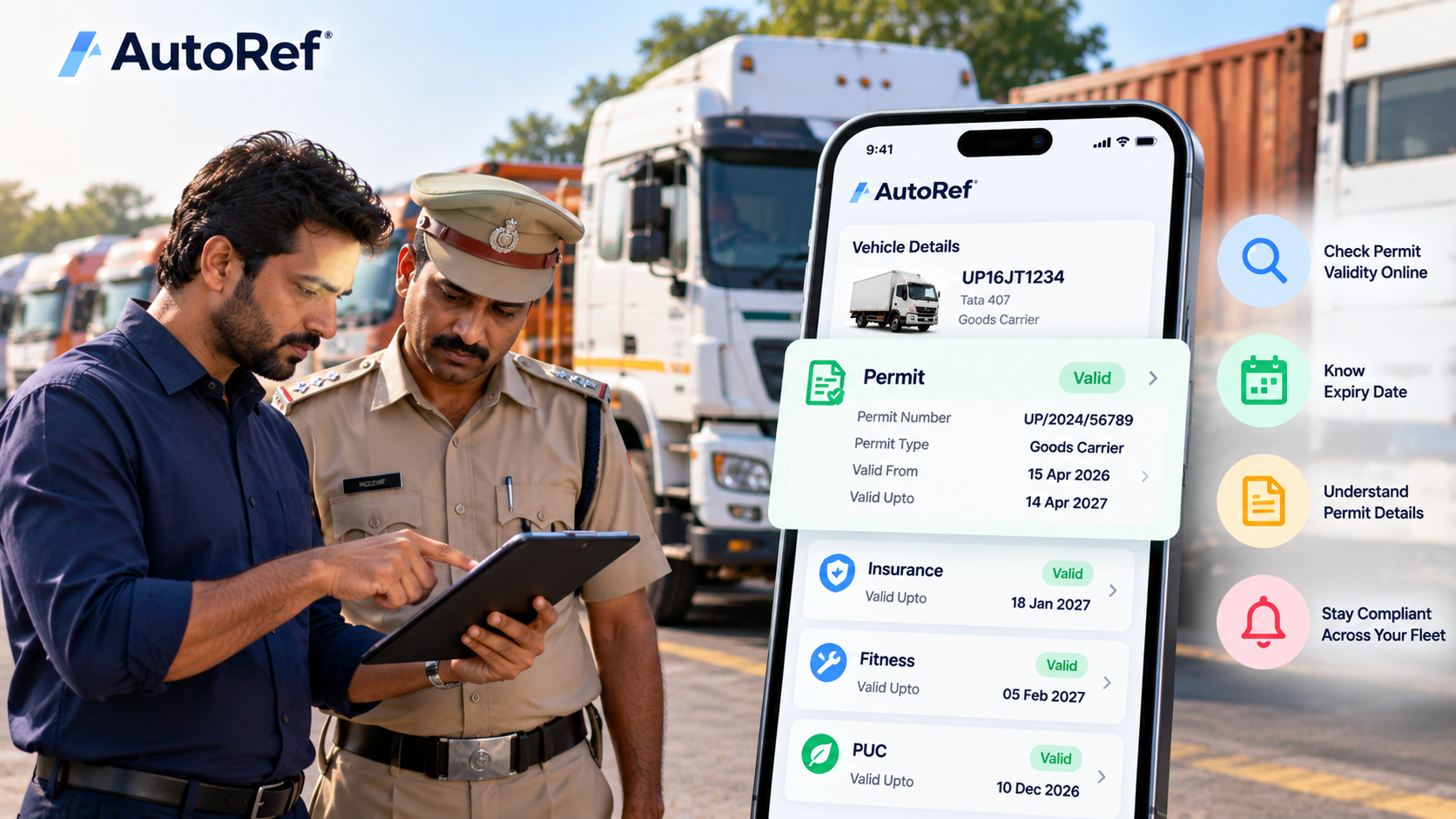 Car Maintenance & Upkeep
Commercial Vehicle Permit: How to Check Validity and Expiry
Commercial Vehicle Permit: Check Validity & Expiry
 Car Maintenance & Upkeep
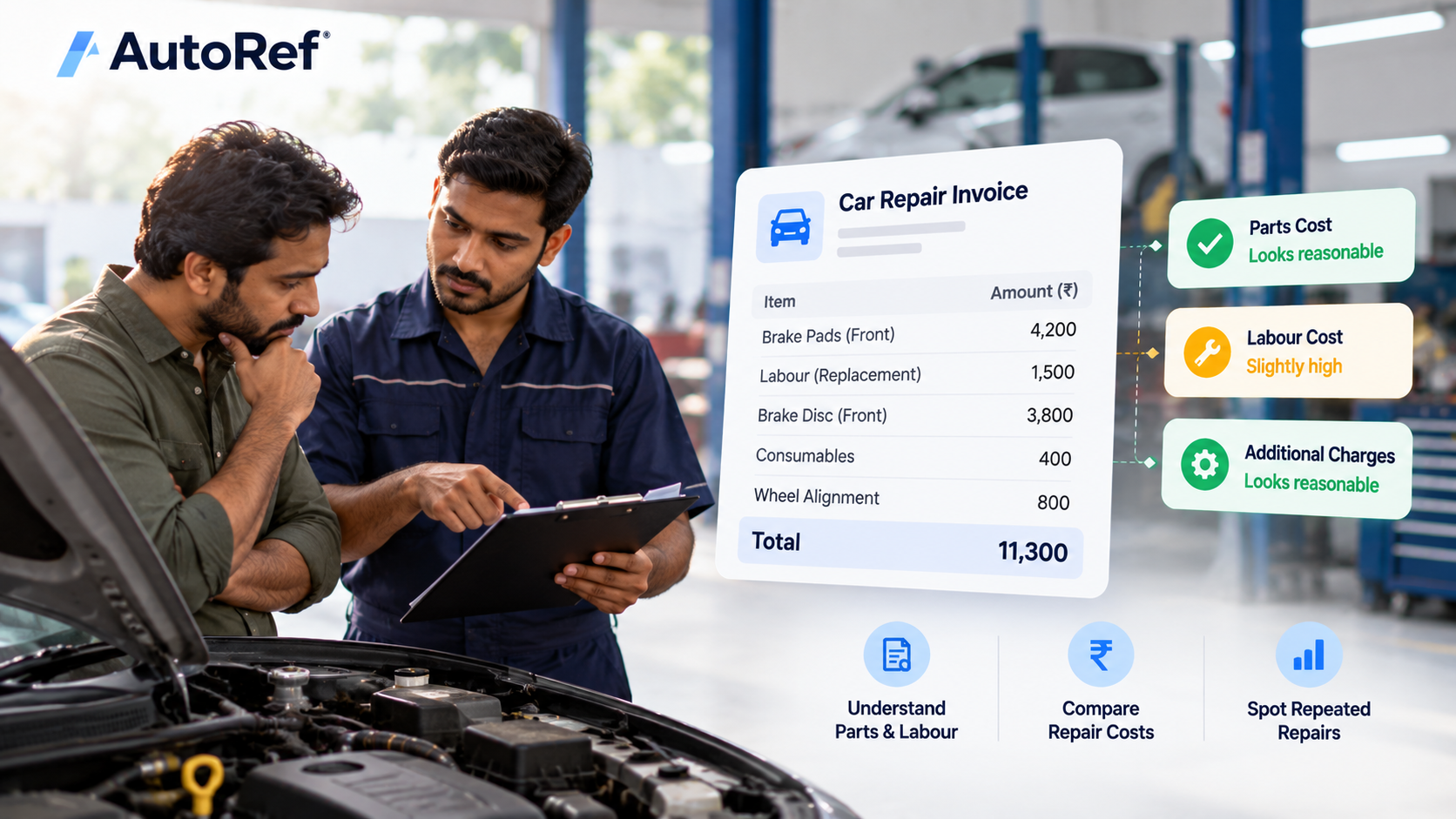
How to Check If a Car Repair Cost Is Reasonable
Learn how to check car repair costs, compare parts and labour, identify repeated repairs and evaluate repair bills for your car or fleet.
 Car Maintenance & Upkeep
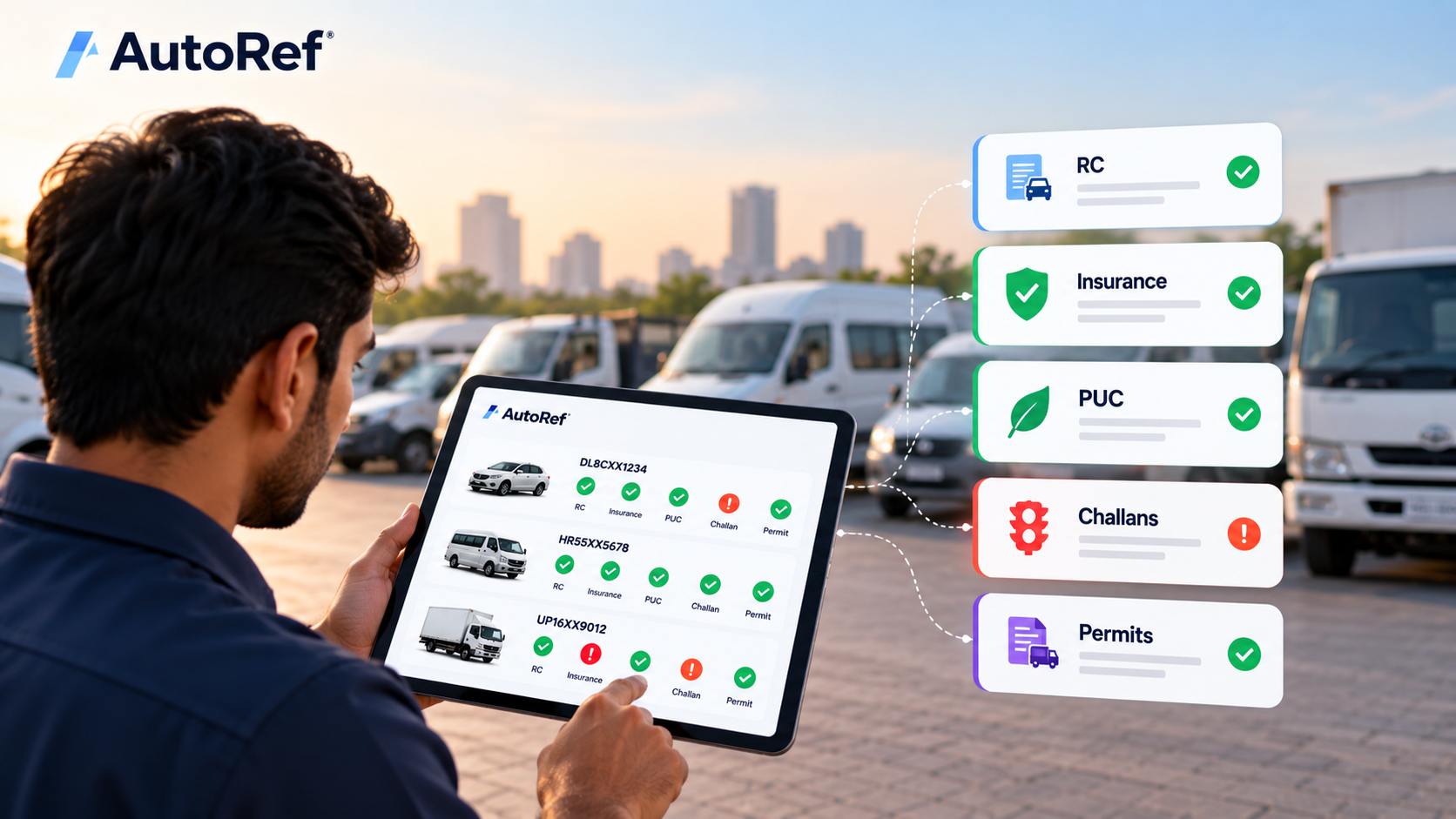
Vehicle Compliance Checklist: RC, Insurance, PUC, Challans and Permits
Vehicle compliance checklist covering RC, insurance, PUC, challans and permits, with practical tips for individual owners and commercial fleets.