Introduction
Getting a car serviced should not end with simply checking the total amount at the bottom of the bill.
The difficult part for many owners is understanding what each line actually means, why it was added and whether the vehicle really needed it.
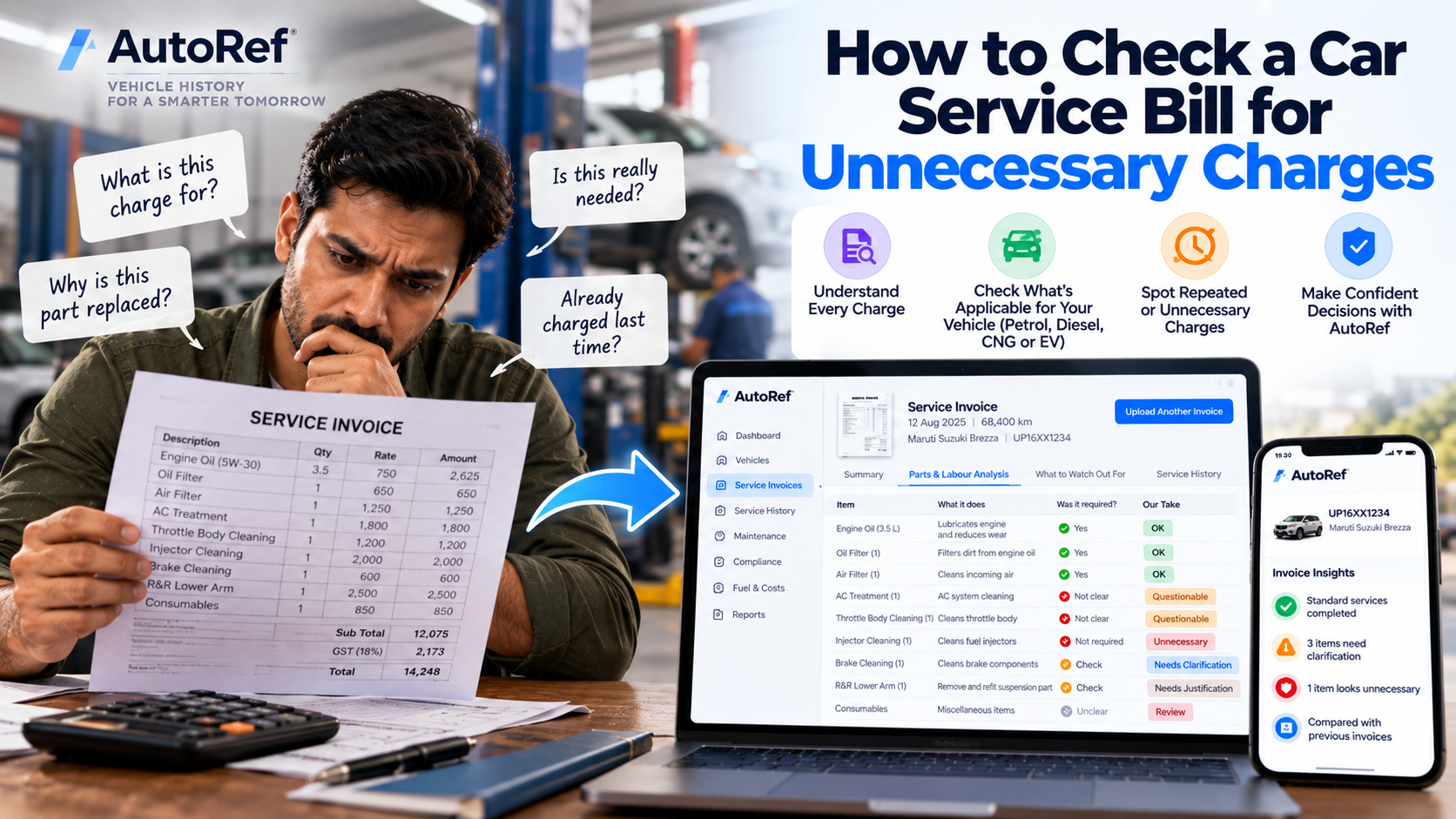
A service invoice may contain terms such as R&R, throttle body cleaning, injector cleaning, consumables, brake service, AC treatment, scan charges or a manufacturer-specific part number. To someone who does not work around cars every day, these terms can make a routine invoice difficult to evaluate.
That problem is increasingly important because modern cars are not mechanically identical. A petrol, diesel, CNG and EV can have very different maintenance requirements.
The first mistake: judging the bill only by the total
Suppose two owners receive these invoices:
Car A: ₹8,400
Car B: ₹8,700
The totals look similar. But Car A might contain routine oil and filter work, while Car B could include a ₹2,500 additional cleaning treatment.
The total alone tells you very little.
Instead, start with three questions:
What was done? Why was it done? Was it already done recently?
1. Check What Your Vehicle Actually Needs
The invoice should be considered against the vehicle's manufacturer schedule and actual condition.
There is a good reason not to assume that every car needs the same items at the same mileage.
For example, Hyundai's current maintenance tables show engine oil and oil-filter replacement at 10,000 km/1 year for several petrol models, while air-filter replacement can be scheduled at 30,000 km/3 years on models such as the Grand i10 Nios, Aura and Exter. For several diesel models, the air and fuel filters have different intervals. Hyundai's EV schedules also differ, for example, the IONIQ 5 lists AC filter replacement at 10,000 km/1 year and brake-fluid replacement at 30,000 km/2 years.
This means a line item should never be judged simply by the fact that it appears on an invoice.
Petrol/CNG
An invoice may contain engine oil, oil filter, air filter, cabin filter, spark plugs or brake-related work depending on the model and service interval.
Diesel
There may be diesel-specific filter and emissions-related components, with different replacement schedules from petrol vehicles. Hyundai, for example, lists fuel-filter replacement at 20,000 km/2 years for several diesel models.
EV
An EV does not have an engine oil and engine oil-filter replacement in the same way as an ICE vehicle. Yet it still has brake fluid, cabin filters, coolant on applicable models, tyres, suspension and other systems requiring inspection or maintenance. Hyundai's EV maintenance tables explicitly show different intervals for brake fluid, AC filters and coolant.
So when an owner sees an unfamiliar charge, the question should be:
"Is this applicable to my specific vehicle and service interval?"
2. Don't Get Trapped by Technical Jargon
Consider this invoice line:
"Throttle body cleaning – ₹1,200"
Many owners will not know whether that is standard maintenance, a condition-based repair or an optional recommendation.
Rather than saying "remove it," ask the workshop:
"What problem did you find that requires throttle-body cleaning, and what did the inspection show?"
If the answer is vague, ask for the issue or observation to be recorded.
Another example:
"R&R – ₹1,500"
Ask:
"Which component was removed and refitted, and why was the work required on this service?"
The goal is not to question every charge. It is to make an unfamiliar technical term understandable before paying for it.
3. Look for Repeated Charges
This is one of the most useful checks a car owner can make.
Suppose your April invoice contains:
AC cleaning – ₹900
and your September invoice again contains:
AC cleaning – ₹900
That does not automatically make the second charge unnecessary. The vehicle may genuinely require the work again.
But now you have a reason to ask:
"This appears on my previous invoice too. What changed or what new condition was found that requires it again?"
This is where historical car maintenance records become powerful.
Without history, you see two individual invoices.
With history, you see a pattern.
4. Compare the Current Bill With Previous Invoices
A service centre may recommend:
- - Brake pad replacement
- - Battery replacement
- - Coolant
- - Cleaning
- - Wheel alignment
- - Suspension components
- - Additional consumables
Before approving, look at when the same component or service appeared previously.
For example:
January: Front brake pads replaced at 42,000 km
September: Front brake pads recommended again at 49,000 km
That does not prove the recommendation is wrong. But it is enough to ask:
"The front brake pads were replaced at 42,000 km. What is their current measured condition, and why do they need replacement again after 7,000 km?"
That is a much stronger question than simply saying, "I don't think this is required."
5. AutoRef Turns an Invoice Into a Decision Aid
This is where AutoRef becomes useful.
Without AutoRef
Garage → recommendation → complex invoice → owner looks only at total → approval
The owner may not remember previous work and may not understand technical terms.
With AutoRef
Previous vehicle history → current invoice → parts & labour analysis → repeated/unusual items identified → specific questions → approval
AutoRef analyses service invoices and organises parts and labour against the vehicle's history. This gives the owner context before making a decision. It works well with vehicles of all brands.
For example, if the invoice contains an unfamiliar ₹1,800 "cleaning/service/cosmetic" item and AutoRef's history shows a similar service was billed recently, the owner has a concrete reason to ask for clarification.
The system is not replacing the mechanic's inspection. It is helping the owner understand what to ask and why.
6. The Same Problem Appears With Small Fleets
For an individual, one invoice can be confusing.
For a small fleet owner, the problem can become trust-based decision making.
Imagine an owner operating three taxi cars.
The driver drops the car at the agency. The agency recommends brake work and sends an invoice for ₹9,500.
The owner may either:
"Driver said the brakes were bad, so approve it."
or:
Check the vehicle's previous history, review the invoice, understand what was changed and then approve the work.
That second process is particularly useful when the owner is not personally present at every workshop visit.
7. What Charges Should You Question?
There is no universal list of "unnecessary" charges because a service can be genuinely required for one vehicle and inappropriate for another.
Instead, question charges when:
- - The item is unfamiliar.
- - It was not discussed beforehand.
- - It appears repeatedly in a short period.
- - It does not appear relevant to the vehicle's service interval.
- - The workshop cannot clearly explain the reason.
- - The vehicle history suggests the same component was recently replaced.
The right question is usually more useful than an accusation.
Instead of:
"Why are you charging me this?"
Ask:
"What condition or inspection finding caused this item to be recommended, and was this part or service already performed previously?"
Conclusion
Knowing how to check a car service bill for unnecessary charges does not mean assuming that a workshop is overcharging you.
It means making the invoice understandable.
Check the vehicle-specific maintenance requirement, separate routine work from additional recommendations, understand unfamiliar jargon and compare the current invoice with your vehicle maintenance records.
For individual owners, this creates more confidence when dealing with a service centre. For small fleet owners, it reduces dependence on the driver's or agency's verbal explanation.
AutoRef adds another layer by analysing the invoice and connecting it with the vehicle's previous records, giving you the context needed to ask better questions before approving the bill.
Frequently Asked Questions
Can AutoRef identify potentially unnecessary charges on a car service bill?
AutoRef can analyse invoice line items and highlight items that may require confirmation, questioning or justification based on the available vehicle and service context. A flagged charge is not automatically an incorrect charge.
Can AutoRef compare my current bill with previous service invoices?
Yes. AutoRef keeps invoice and maintenance information associated with the vehicle, allowing previous work to provide context when reviewing a new service bill.
Does AutoRef support different vehicle fuel types?
AutoRef's invoice-analysis workflow is designed around the vehicle and its applicable context, which helps distinguish maintenance considerations across petrol, diesel, CNG and EV vehicles. Actual maintenance requirements should still be verified against the manufacturer's schedule and vehicle inspection.
Can small fleet owners use AutoRef before approving garage bills?
Yes. A fleet owner can review the vehicle's previous maintenance history and current invoice information before approving work recommended by a driver, garage or service agency.
Related Articles
All Vehicle Compliance →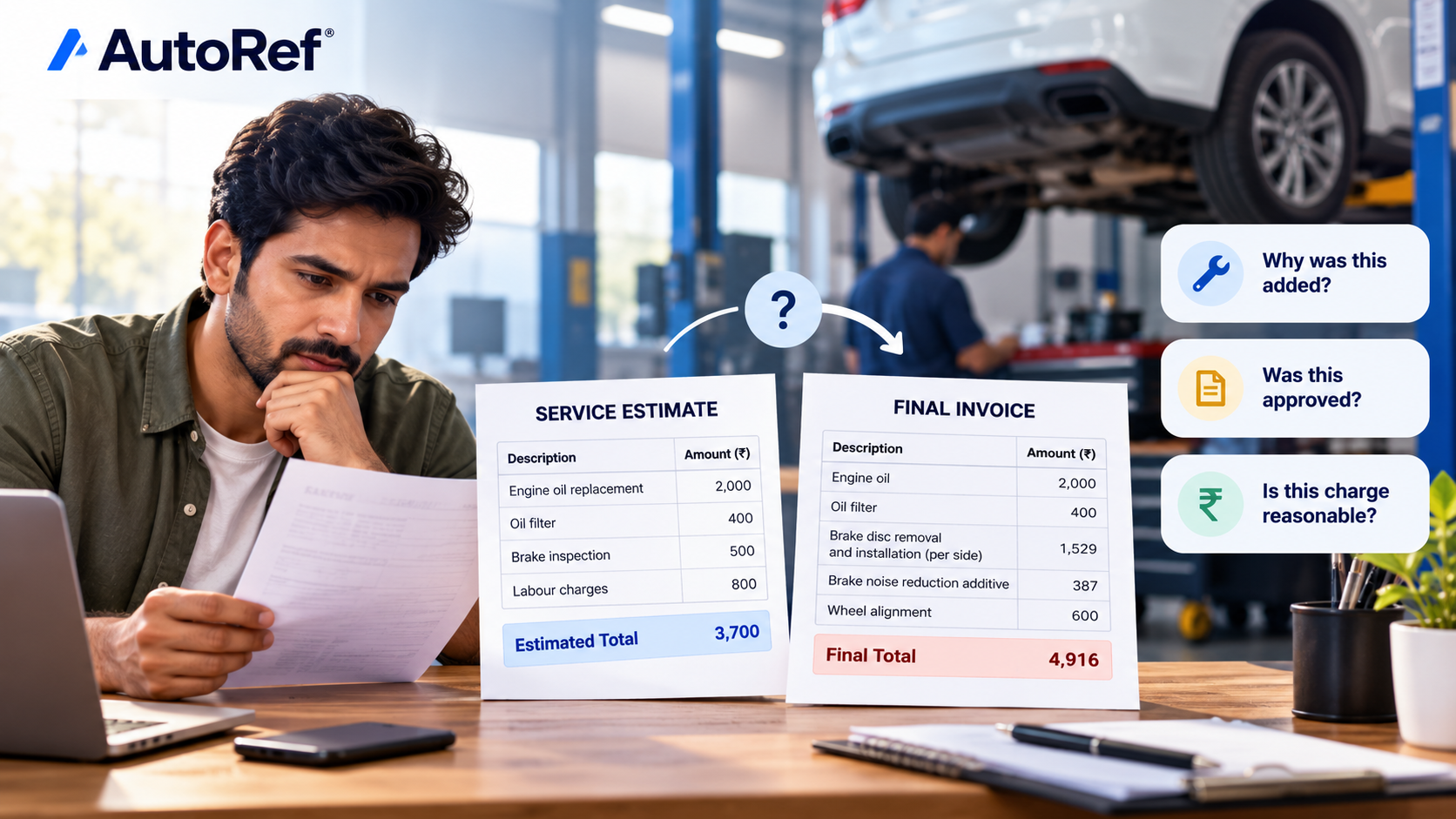 Vehicle Compliance
Car Service Estimate vs Final Invoice: What Should You Check?
Compare your car service estimate with the final invoice. Learn to check added parts, labour, unexplained charges, and how AutoRef helps you question them.
 Vehicle Compliance
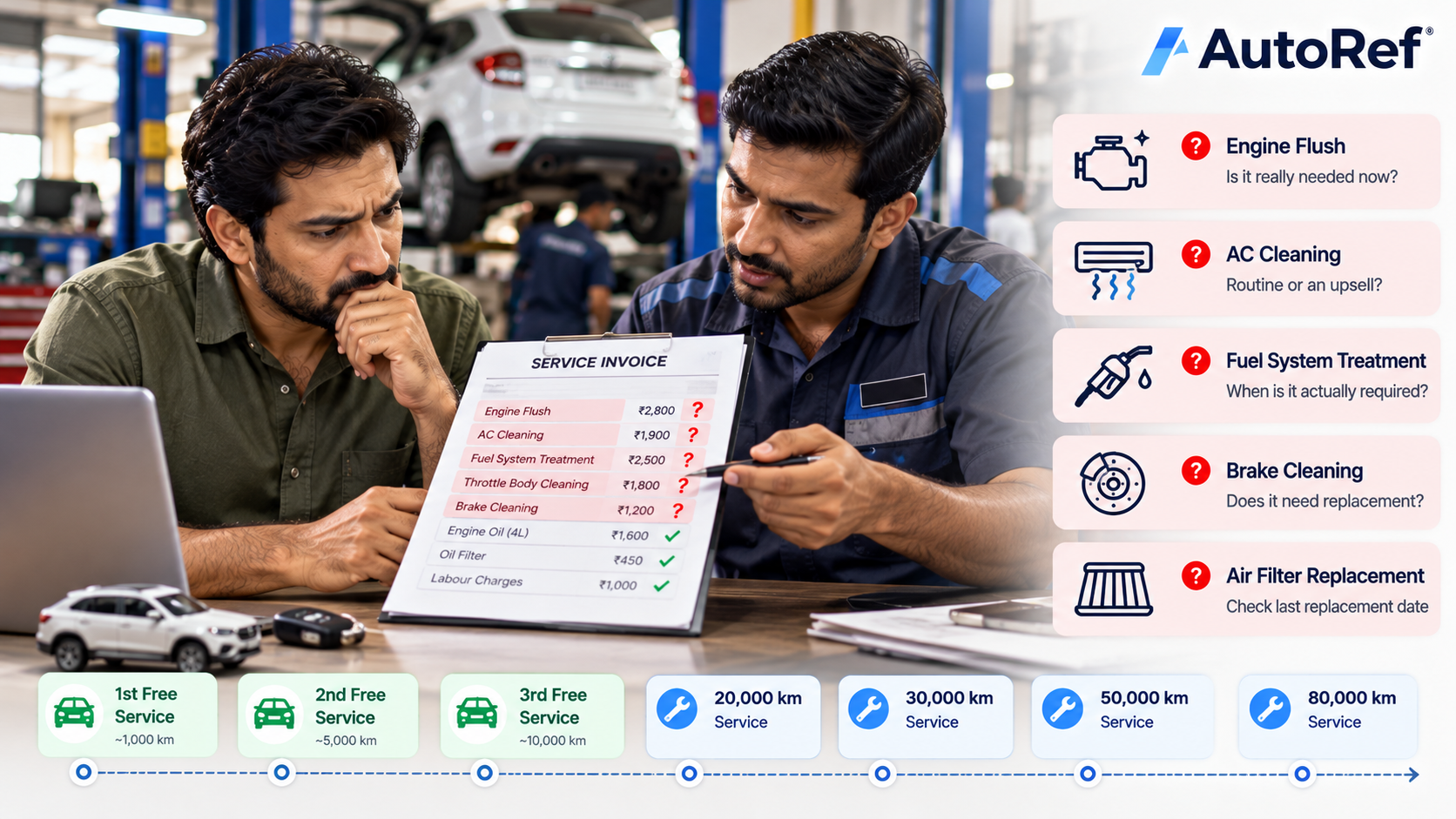
Common Car Service Upsells: What Should You Question?
Learn which car service upsells to question, from free services to 80,000 km, and how service history can help you review extra charges.
 Vehicle Compliance
How to Check Vehicle Challans Online
Learn how to check vehicle challans online, understand common offences, pay pending challans safely and track challans across multiple vehicles.