
Introduction
Reaching 30,000 km is more than a number on the odometer. Depending on the vehicle, this may be a major scheduled service, a routine periodic service or simply another inspection interval.
There is one important rule to remember: 30,000 km does not mean every car needs exactly the same parts replaced. Your owner's manual and manufacturer schedule should remain the primary reference.
For example, Hyundai's published maintenance schedules show different replacement intervals by model and engine. For several petrol models, the engine oil and oil filter are listed at 10,000 km/1 year, while the air filter may be due at 30,000 km/3 years. Spark-plug and brake-fluid intervals vary by model. Hyundai
So the right question is not simply, "What is changed at 30,000 km?"
It is:
"What is due on my particular car at 30,000 km, and which additional work actually needs to be done?"
1. Start With the Manufacturer's 30,000 Km Schedule
Before approving any work, check the maintenance schedule for your exact:
- - Make and model
- - Variant/engine
- - Fuel type
- - Vehicle age
- - Current odometer reading
- - Previous service history
A manufacturer's schedule may specify inspections, replacements or fluid checks at particular mileage or time intervals.
For example, Tata Nexon's published service schedule lists its 30,000 km/24-month service at around ₹7,600 for petrol, ₹8,800 for diesel, and ₹8,000 for CNG in the referenced schedule, with items such as oil, filters, spark plugs or brake fluid depending on the fuel type.
That illustrates why copying another owner's checklist can be misleading.
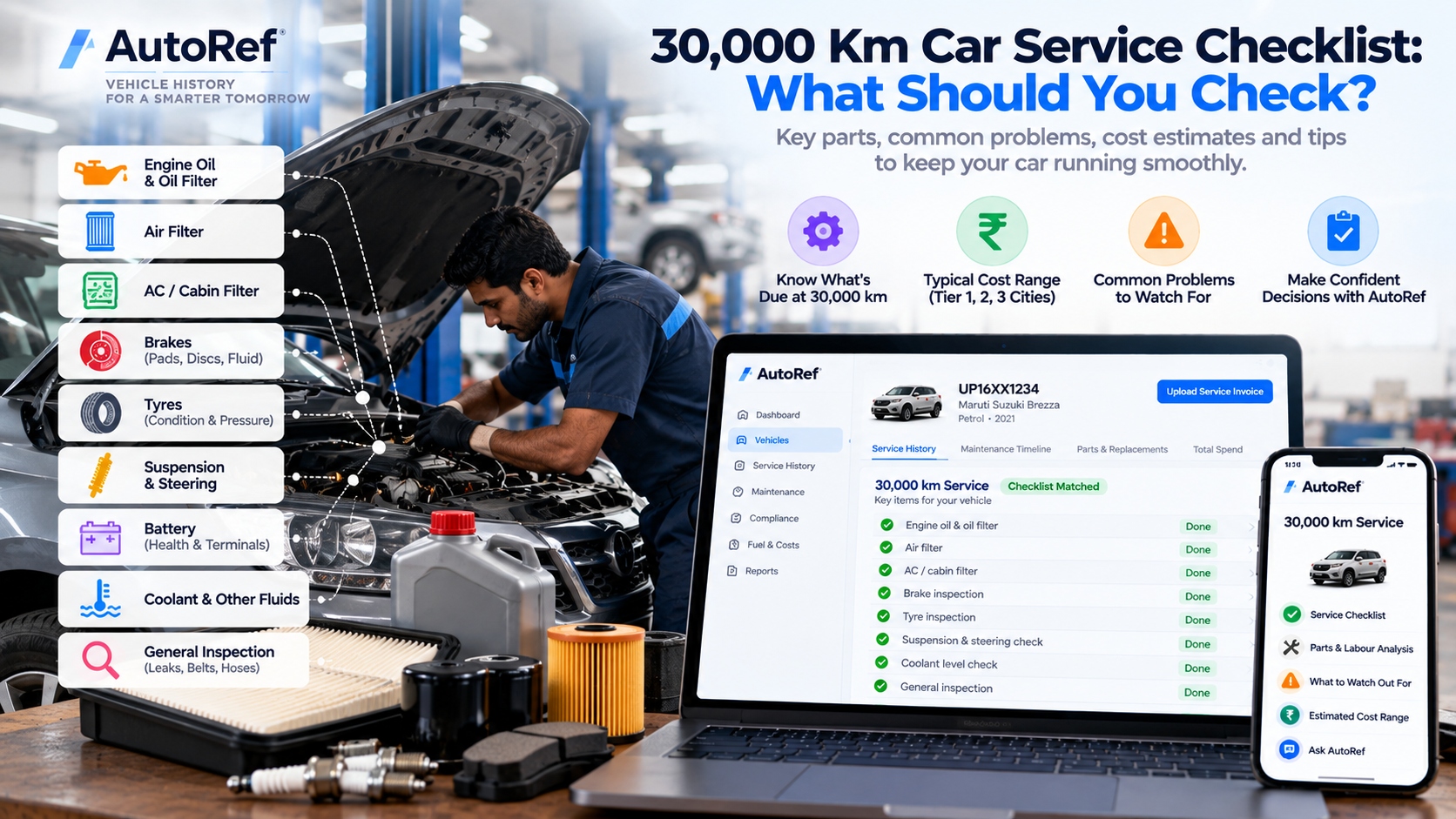
2. Common Items to Check at 30,000 Km
Although the exact checklist varies, these are common areas to inspect.
Engine oil and oil filter
Check whether the engine oil and oil filter are due according to the manufacturer's interval.
Do not assume that every 30,000 km service requires a fresh oil change—the vehicle may already have had oil replaced at 10,000 km or another interval. Hyundai's published schedules, for example, list engine oil and oil filter replacement at 10,000 km/1 year for several models.
Air filter
Inspect the engine air filter and replace it when the schedule or condition requires it.
AC/cabin filter
Check the cabin or climate-control filter. Brands lists a 20,000 km/2-year interval on several models, while other vehicles can differ significantly.
Brake system
Inspect:
- - Brake pad thickness
- - Brake discs/rotors
- - Brake fluid
- - Brake lines
- - Parking brake
Brake pads should not be replaced merely because the car has crossed 30,000 km. Their condition and remaining thickness matter.
Tyres
Inspect tread depth, uneven wear, tyre age and pressure. Uneven wear can also indicate an alignment or suspension issue.
Suspension and steering
Look for worn bushes, ball joints, tie rods, shocks/struts and unusual play or noise.
Battery
Check battery health, terminals and charging behaviour rather than replacing the battery purely based on mileage.
Coolant and other fluids
Inspect coolant, brake fluid and other applicable fluids. Replacement intervals differ by model. Hyundai's schedules, for example, show coolant replacement patterns that can extend well beyond 30,000 km on several petrol models. Hyundai
3. Common Problems Owners Notice Around 30,000 Km
At this kms range, owners may begin reporting issues that are not necessarily part of a standard periodic service:
Brake noise or reduced braking: Can indicate pad/disc wear, but requires inspection rather than automatic replacement.
Uneven tyre wear: May point to alignment, balancing, suspension or tyre-pressure issues.
Cabin cooling problems: Could involve the AC filter, refrigerant, compressor or another system component.
Reduced fuel efficiency: Can have many causes, including driving conditions, tyre pressure, service condition or mechanical issues.
Battery weakness: Short trips, heat and battery age can matter more than odometer reading.
Suspension noise: Worn bushes or other components may become noticeable with use, particularly on poor roads.
The important distinction is between scheduled maintenance and condition-based repairs.
4. How Much Does a 30,000 Km Service Generally Cost?
There is no single India-wide price because vehicle model, engine, parts and city all influence the bill.
For example, Hyundai explicitly states that its service calculator estimates can vary city-wise and provides separate parts and labour components.
As a practical planning range for mainstream passenger cars, you can use the following as an indicative budget, not a quoted market rate:
| City type | Routine 30,000 km service | With additional repairs/parts |
|---|---|---|
| Tier 1 | ₹5,000–₹10,000 | ₹10,000–₹20,000+ |
| Tier 2 | ₹4,000–₹8,000 | ₹8,000–₹16,000+ |
| Tier 3 | ₹3,500–₹7,000 | ₹7,000–₹14,000+ |
Premium cars, diesel vehicles, SUVs and repairs involving brakes, suspension, tyres, battery or other major components can push the invoice substantially higher.
Actual pricing should always be checked against your vehicle and workshop.
5. The Most Important Part: Read the Invoice
This is where many owners struggle.
A service advisor may mention:
- - R&R
- - Consumables
- - Brake cleaning
- - Decarbonisation
- - Throttle-body cleaning
- - AC treatment
- - Wheel alignment
- - Inspection charges
- - Labour codes
Someone familiar with workshop terminology may understand them immediately. Many owners do not and there is nothing unusual about that.
The problem affects both men and women who own cars: the difficulty is often not knowing automotive jargon, not the ability to maintain a car.
Suppose your invoice contains:
"Throttle body cleaning – ₹1,200."
Instead of accepting or rejecting it automatically, ask:
"What issue did you find that required throttle-body cleaning, and what did the inspection show?"
Why ask? Because some manufacturers classify certain value-added services separately from the standard maintenance schedule. Hyundai, for instance, states that certain value-added services are not part of its maintenance schedule and are not mandatory for maintaining basic warranty validity.
Another example:
"Brake cleaning – ₹600."
Ask:
"Was brake cleaning part of the scheduled service, or was it recommended because you found a specific brake issue?"
The question is not about challenging the workshop. It is about understanding why the line is on your invoice.
6. AutoRef Changes the Decision Before You Approve the Bill
Without AutoRef, the process often looks like this:
Service centre → verbal recommendation → owner sees unfamiliar invoice → pays
With AutoRef:
Vehicle history → invoice uploaded → parts & labour analysed → unusual/unclear items highlighted → owner asks specific questions → final approval
For example, imagine a 30,000 km invoice contains engine oil, oil filter, air filter, brake inspection and an additional ₹2,500 "engine treatment."
You can review your previous maintenance history first.
If the treatment has appeared repeatedly, you can ask:
"Was this treatment performed previously, and what specific condition on this vehicle requires it again?"
This becomes especially useful when the owner does not know the service-centre terminology.
7. Fleet Owners Face a Different Version of the Same Problem
A fleet owner with three taxis may not personally take every vehicle to the workshop.
The driver may say:
"Garage ne bola brake pad change karna hai."
The agency may then send an invoice for ₹8,000.
The owner has two choices:
Trust the recommendation and approve it, or check the vehicle's previous history and understand the invoice first.
With AutoRef, the owner can review the vehicle's previous records and invoice analysis before approving additional work.
The same principle applies to hotel cars, ambulances and transport vehicles: do not rely solely on either the driver or the workshop when historical evidence is available.
8. 30,000 Km Service: Do's and Don'ts
Do
- - Check your manufacturer's schedule.
- - Compare the current odometer with the previous service.
- - Review your service history.
- - Ask what each significant additional charge covers.
- - Check parts and labour separately.
- - Upload and analyse the invoice before final approval.
Don't
- - Assume every 30,000 km service is identical.
- - Replace parts solely because a mileage milestone was reached.
- - Approve an unfamiliar service simply because it sounds technical.
- - Assume every item on an invoice is part of the scheduled service.
- - Rely only on a driver's verbal summary for a fleet vehicle.
Conclusion
A 30,000 km car service checklist should be a starting point, not a blanket replacement list.
The exact work depends on your vehicle's manufacturer schedule, engine, age, usage and previous maintenance. The more important skill is being able to distinguish scheduled maintenance, condition-based repairs and optional/additional services.
That becomes much easier when you have your previous service history and can understand the current invoice before approving it.
AutoRef brings those two pieces together: vehicle history and service invoice analysis. Instead of simply asking, "How much is this service going to cost?", you can ask a more useful question:
"What does my car actually need, what has already been done, and what should I confirm before I pay?"
Frequently Asked Questions
Is every 30,000 km service the same?
No. Service intervals and replacement items vary by manufacturer, model, engine and fuel type. AutoRef helps you review your vehicle's previous records and current invoice, but the manufacturer's maintenance schedule remains the primary reference.
Can AutoRef analyse my 30,000 km service invoice?
Yes. AutoRef can analyse uploaded service invoices across parts, labour and other line items and highlight items that may need clarification or confirmation.
Can AutoRef help me decide whether to approve an additional repair?
AutoRef can provide context from the vehicle's recorded maintenance and analyse invoice items, helping you formulate specific questions for the workshop. It does not replace a physical inspection or manufacturer/technician diagnosis.
Can fleet owners use this for multiple vehicles?
Yes. Each vehicle can have its own service and maintenance history. This helps a fleet owner check previous work and the current invoice before approving repairs recommended by an agency, workshop or driver.
Related Articles
All Car Service & Repair →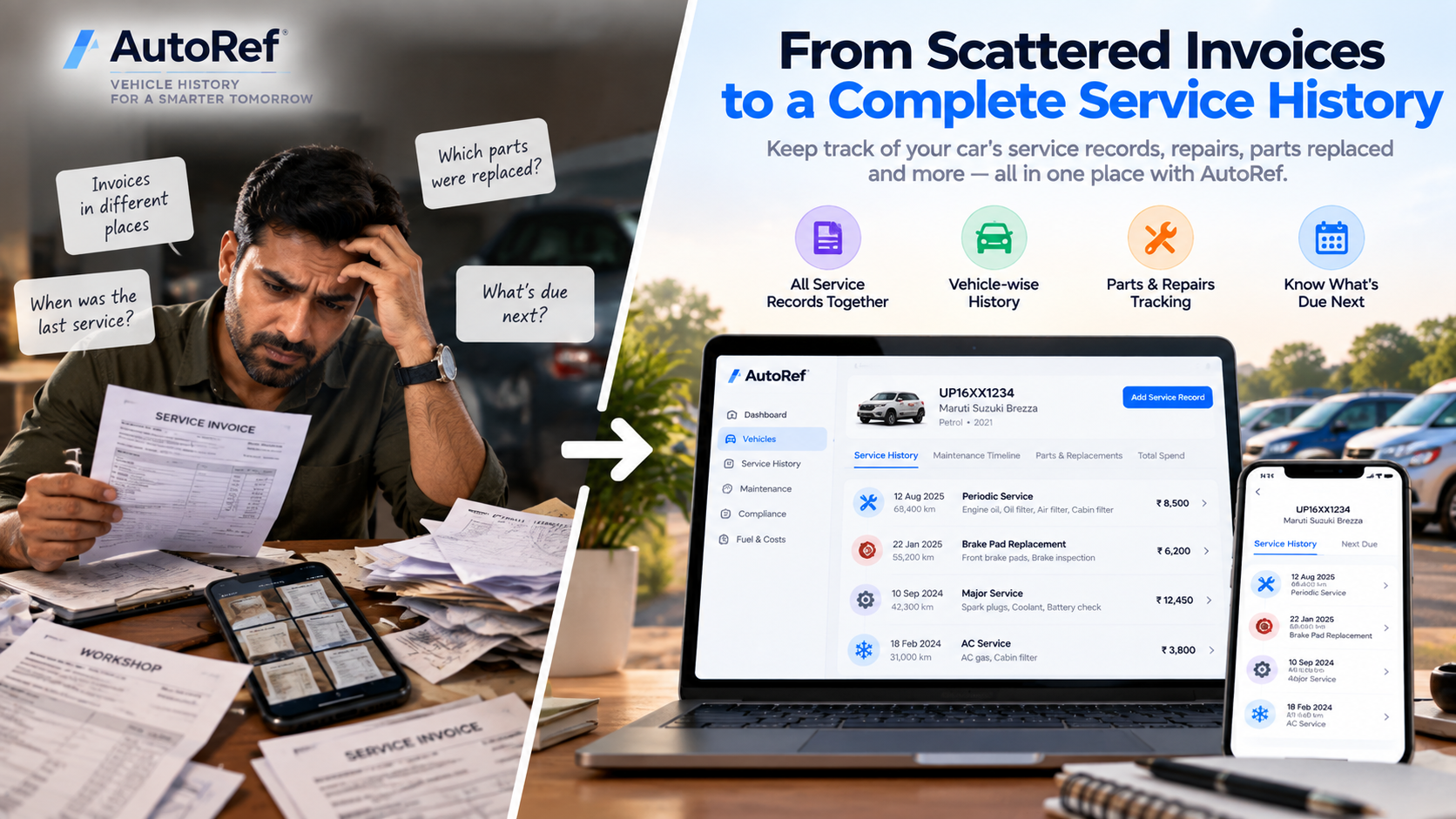 Car Service & Repair
How to Keep Track of Your Car Service History
Learn what to record in your car service history, how to organize invoices, log mileage and parts, and use records to plan maintenance with confidence.
 Vehicle Compliance
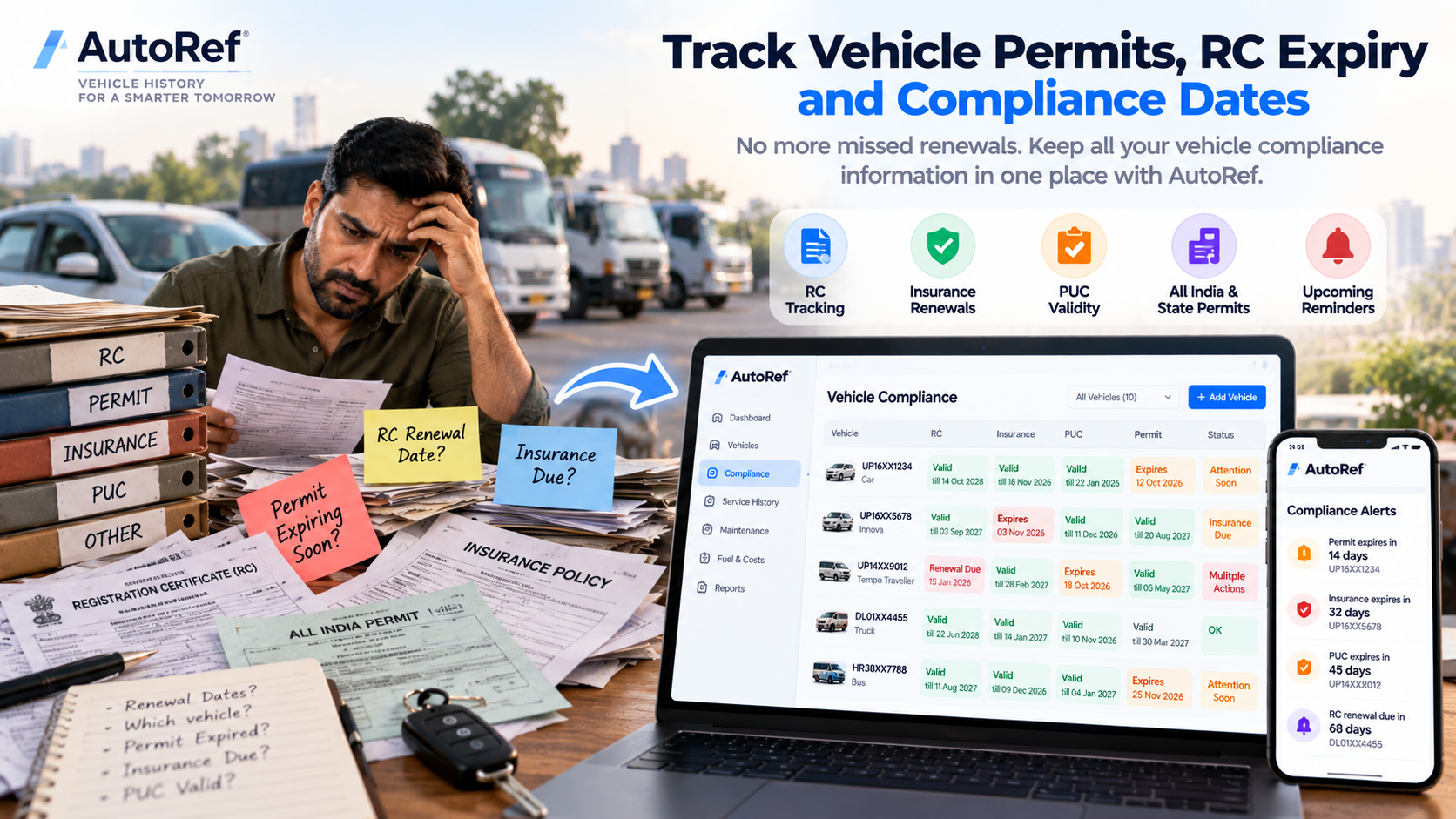
How to Track Vehicle Permits, RC Expiry and Compliance Dates for a Fleet
Track vehicle permits, RC, insurance, PUC and other expiry dates with a practical vehicle compliance checklist for owners and small fleets.
 Vehicle Compliance
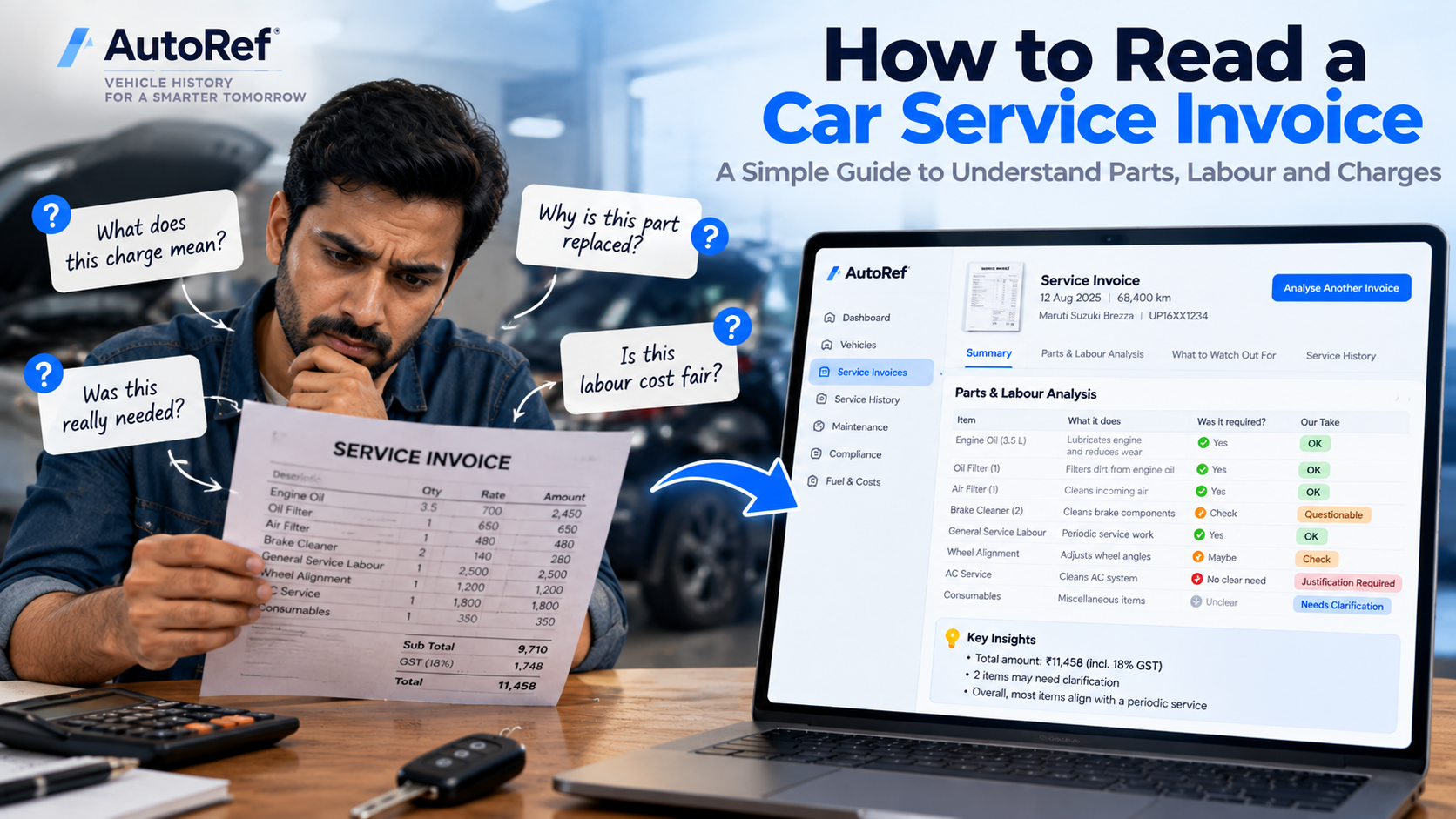
How to Read a Car Service Invoice: A Simple Guide
Learn how to read a car service invoice, understand parts, labour, quantities and taxes, and identify charges that may need clarification.