
Introduction
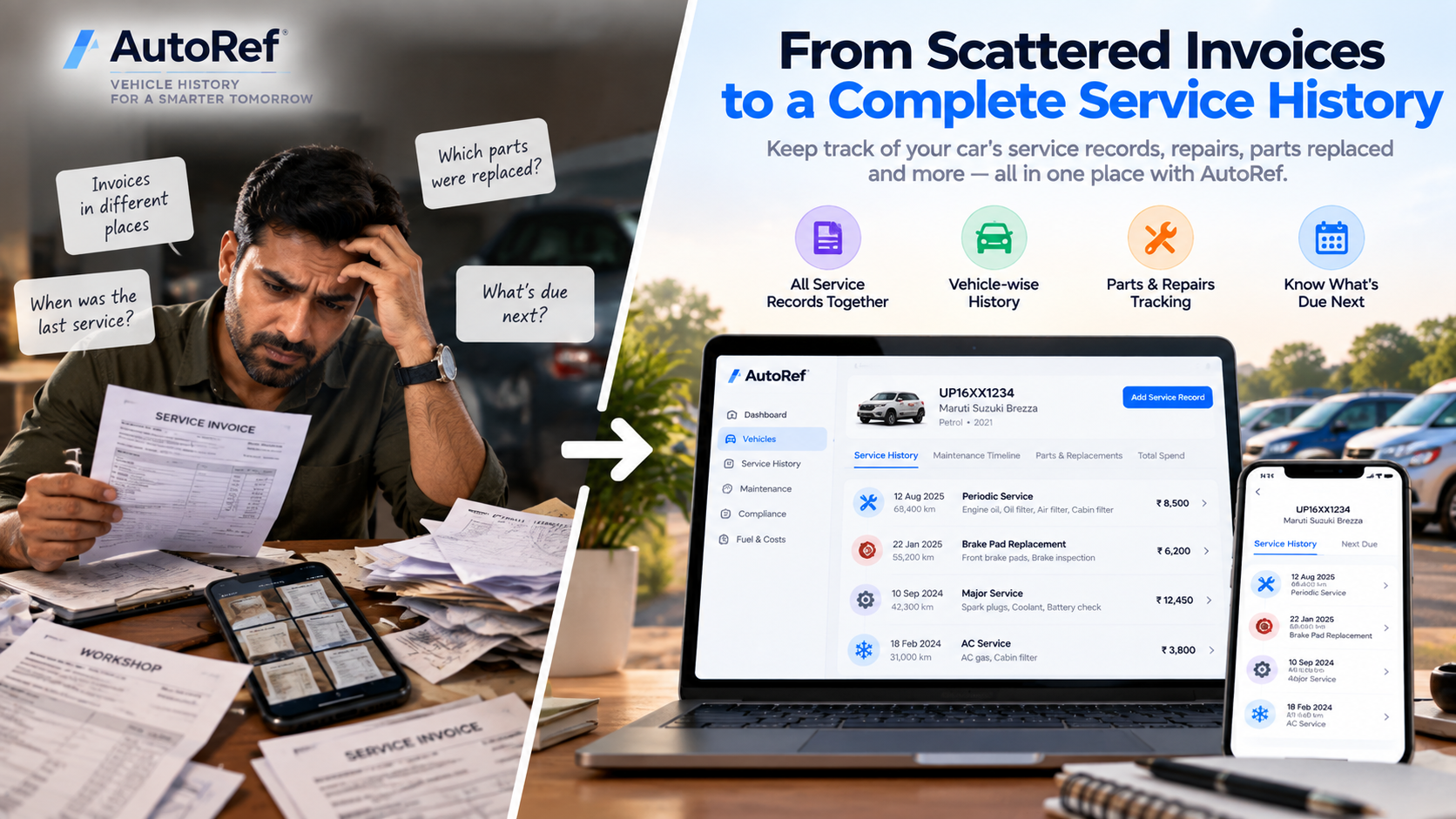
Most car owners remember when they bought their car. Fewer can remember exactly when the brake pads were replaced, when the battery was changed, or whether the last major service included coolant, filters and other consumables.
That information becomes important as a vehicle gets older.
Your car service history is essentially a record of the maintenance and repairs performed on your vehicle over time. It can help you understand what has already been done, avoid unnecessary repeat work and make better decisions about upcoming maintenance.
The challenge is keeping that history organised.
What Should a Car Service History Include?
A useful service record should capture more than just the date of the service.
For each visit, try to record:
- - Service date
- - Odometer reading
- - Type of service
- - Parts replaced
- - Parts repaired
- - Labour performed
- - Invoice amount
- - Important observations
- - Next recommended service or replacement
For example, instead of recording:
"Service @42,300 costed ₹8,500"
a useful record would say:
| Odometer Reading | 42,300 kms |
| Kind of Service | Periodic service |
| Major Replacements | Engine oil + oil filter replaced |
| Inspections Done | Brake inspection and Battery Checked |
| Cost | ₹8,500 |
| Garage | Shree Krishna Motors |
The second record gives you information that can actually be used later.
1. Keep Your Service Invoices
The easiest starting point is to retain your service invoices.
Whether the work is performed at an authorised service centre, independent workshop or local garage, the invoice can contain valuable information about the vehicle's previous maintenance.
Consider a car that has had three services:
- - 10,000 km – engine oil and filters
- - 20,000 km – periodic service and brake inspection
- - 31,000 km – battery replacement and brake work
If these invoices are scattered across email, WhatsApp, paper files and photographs on your phone, finding the complete service history of a car later can be surprisingly difficult.
Keeping them together creates a much more useful record.
2. Record the Odometer Reading
Mileage provides important context to a service record.
Suppose your previous service was at 30,000 km and your current odometer shows 39,500 km. You can immediately understand how much the vehicle has been driven since the last service.
This is particularly useful for owners who follow mileage-based maintenance intervals.
It also becomes valuable when you operate multiple vehicles. A taxi that travels 5,000 km every month will have very different maintenance requirements from a personal car travelling 800 km a month.
3. Record What Was Actually Replaced
A service history should help answer a simple question:
"When was this part last replaced?"
Imagine your car has crossed 60,000 km and you are trying to determine whether the battery, tyres, brake pads or other wear items were replaced recently.
Without records, you may depend on memory or the workshop's recommendation.
With a properly maintained vehicle service record, you can check what was previously done before approving new work.
This can also help prevent unnecessary duplication.
4. Use Service History When Planning Future Maintenance
A service record becomes more valuable as it grows.
Suppose you discover that your vehicle's previous maintenance records show brake pads were replaced at 35,000 km and the car is now at 55,000 km.
That does not automatically mean the brake pads need replacement again. Their actual condition still needs to be inspected.
However, the historical record tells you that this is something worth checking.
This is the difference between simply storing invoices and actually using vehicle maintenance records to make decisions.
5. The Problem Gets Bigger With Multiple Vehicles
For someone with one car, maintaining records manually may be manageable.
For someone operating three vehicles, the situation changes.
Consider a small taxi operator with three cars:
| Vehicle | Current KM | Last Service | Last Major Work |
|---|---|---|---|
| Car A | 68,400 | 65,000 km | Brake pads |
| Car B | 42,200 | 40,000 km | Battery |
| Car C | 91,600 | 88,000 km | Suspension work |
Without a central record, the owner may have to search through individual invoices or ask the drivers.
The same challenge becomes much larger for organisations operating hospital ambulances, hotel cars, transport vehicles or larger taxi fleets. Different vehicles may be serviced at different workshops and at completely different mileage intervals.
6. Keep the History Connected to the Vehicle
The most useful approach is to maintain the service history vehicle by vehicle.
Instead of having a folder called "Car Invoices", create a digital record on Autoref where every service, repair and invoice belongs to a specific vehicle.
This allows you to answer questions such as:
- - What was done during the previous service?
- - When was a particular component replaced?
- - How much has this vehicle cost to maintain?
- - What is the latest recorded mileage?
- - What work has already been performed?
AutoRef follows this vehicle-level approach, allowing owners to maintain service and maintenance information against individual vehicles.
Conclusion
A car service history is more than a collection of old invoices. It is a record of what has happened to the vehicle and a reference point for making future maintenance decisions.
For an individual owner, it can prevent forgotten maintenance details. For someone managing two or three vehicles, it can eliminate the need to search through separate files for every car. And for operators of taxis, ambulances, hotel vehicles or transport vehicles, structured vehicle-level records can make maintenance information much easier to manage.
The important part is to start recording the information consistently: date, mileage, work performed, parts replaced and cost.
The longer you maintain that history on Autoref, the more useful it becomes.
Frequently Asked Questions
Can AutoRef store my car service records?
Yes. AutoRef is designed to keep your vehicle's service and maintenance records together. You can maintain information from different service visits, including the work performed and invoice details, giving you a consolidated history for each vehicle.
How can I keep track of my car service history?
AutoRef lets you maintain a vehicle-level service history by keeping service invoices and maintenance information associated with the specific vehicle. Instead of searching through paper invoices, emails or phone galleries, you can refer back to the vehicle's recorded history when planning or reviewing maintenance.
Can AutoRef show what was done during previous services?
AutoRef maintains the information associated with the vehicle's service records, allowing you to refer back to previous maintenance and repair work. This can help you understand what has already been done before discussing the vehicle's next service or repair.
Is AutoRef useful for a small taxi or commercial fleet?
Yes. A small operator can maintain each vehicle separately while keeping its service and repair history organised. For example, a taxi operator with three vehicles can see the maintenance history of each vehicle rather than relying on drivers or separate paper invoices to understand previous work.
Can AutoRef replace the service history maintained by a manufacturer or workshop?
No. AutoRef is not intended to replace an authorised manufacturer's or workshop's official records. It provides an independent vehicle-level record that brings together the maintenance and invoice information you choose to maintain, including work performed across different workshops.
Can AutoRef help me understand my service invoices?
Yes. AutoRef can analyse service invoices to identify parts, labour and other line items and provide explanations around the work and charges. This is particularly useful when you want to understand what you paid for and whether a particular item needs further clarification.
Can I upload old service invoices to AutoRef?
Yes. AutoRef allows you to upload service invoices and uses invoice analysis to extract and organise relevant information from them. This helps turn individual invoices into a more useful vehicle maintenance history rather than leaving them as disconnected documents.
Can I track service history for multiple vehicles?
Yes. AutoRef is built around individual vehicle records, so you can maintain separate histories for multiple vehicles. This is useful for owners with two or three vehicles as well as operators managing taxi cars, hotel vehicles, ambulances or other small fleets.
Related Articles
All Car Service & Repair → Vehicle Maintenance Records
How to Check Car Insurance Expiry Date Online
Learn how to check your car insurance expiry date online using your policy, insurer portal and mParivahan, and how to track expiry dates for multiple vehicles.
 Fleet Vehicle Downtime Management
How to Reduce Vehicle Downtime in a Fleet
Learn how to reduce fleet downtime through preventive maintenance, repair tracking, vehicle history and better prioritization of maintenance.
 Fleet Vehicle Downtime Management
Fleet Vehicle Downtime: A Complete Guide to Reducing Unplanned Downtime
Learn how to reduce fleet vehicle downtime by tracking breakdowns, repairs, maintenance history and vehicle availability.