
Introduction
A car service invoice is supposed to tell you what was done to your vehicle and how much you paid for it. In reality, many owners receive a bill containing part numbers, abbreviations, labour codes, quantities, taxes and miscellaneous charges that are difficult to interpret.
The problem is not always whether the invoice is correct. Often, the problem is simply not understanding what the charges mean.
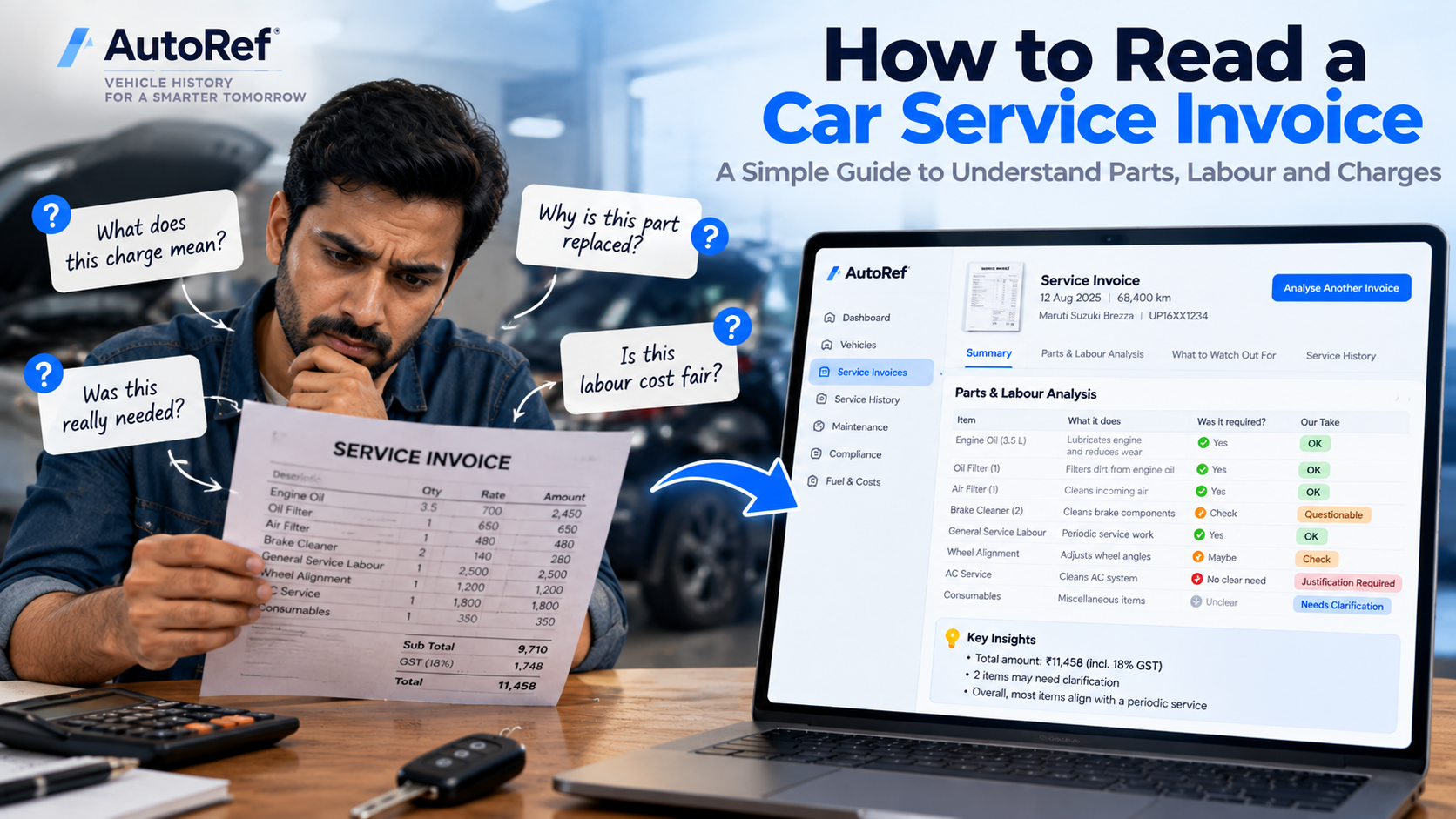
For example, an invoice could show:
| Item | Quantity | Amount |
|---|---|---|
| Engine Oil | 3.5 L | ₹2,450 |
| Oil Filter | 1 | ₹650 |
| Brake Cleaner | 2 | ₹280 |
| General Service Labour | 1 | ₹2,500 |
A car owner may understand the engine oil and filter but still wonder: What does the labour charge include? Why was brake cleaner used? Was every item actually required?
Reading the invoice systematically can help answer those questions.
1. Start With the Vehicle and Service Details
Before looking at individual charges, verify that the invoice belongs to your vehicle.
Check the:
- - Registration number
- - Vehicle model
- - Invoice date
- - Odometer reading
- - Service type
- - Workshop or dealer details
The odometer reading is particularly useful.
Suppose your car was serviced at 40,200 km. Your previous service record shows a service at 30,100 km. That 10,100 km difference provides context for understanding why certain scheduled maintenance items may have appeared on the invoice.
This is also why keeping car maintenance records is useful over time.
2. Separate Parts From Labour
One of the easiest ways to understand a service bill is to divide the charges into two broad groups: parts and labour.
Parts may include:
- - Engine oil
- - Oil and air filters
- - Brake components
- - Batteries
- - Belts
- - Spark plugs
- - Coolant
- - Other replacement components
Labour represents the work performed, such as servicing, inspection, removal and installation or repair work.
For example, if a brake pad replacement shows ₹4,500 for parts and ₹1,200 for labour, your total brake-related cost is ₹5,700 before applicable taxes or other charges.
This distinction becomes important when comparing invoices or trying to understand why the final bill is significantly higher than the price of a particular part.
3. Check Quantity and Unit Price
Do not look only at the final amount.
A line showing:
Engine Oil - 4 L - ₹3,200
should be understood as both quantity and rate.
If the invoice lists a quantity higher than expected, ask the workshop why that amount was used.
This does not automatically mean the charge is incorrect. Different vehicles have different oil capacities, and some invoices may include quantities that are billed or supplied differently from the amount actually poured into the engine.
The same approach applies to consumables and other parts.
4. Understand Labour Codes and Abbreviations
Labour lines are often among the hardest parts of an invoice to understand.
You may encounter terms such as:
- - General service
- - Inspection labour
- - Wheel alignment
- - Brake service
- - AC service
- - Diagnosis
- - R&R or remove-and-refit
- - Cleaning labour
A common problem is that the invoice tells you what labour was billed but not what was actually performed in plain language.
For example, "R&R Front Suspension" may mean removal and refitting of a suspension component, but a car owner may not know which component was involved.
Ask the workshop to explain any labour entry that you cannot connect to the work discussed during the service.
5. Look for Duplicate or Unclear Charges
Some invoices contain multiple lines that appear similar.
Suppose you see:
- Brake inspection - ₹500
- Brake cleaning - ₹350
- Brake service labour - ₹1,000
These may represent three different activities, or some may be bundled components of the same work.
The invoice alone may not provide enough context to determine this.
This is where your previous vehicle maintenance records become valuable. If the same service or component was recently addressed, you have a concrete reason to ask why the work appears again.
6. Compare the Invoice With What Was Discussed
Your service advisor may have initially told you that your car needed:
- - Periodic service
- - Brake inspection
- - Engine oil replacement
But the final invoice might contain additional work such as an air-conditioner treatment, fuel-system cleaning or other services.
Additional work is not necessarily unnecessary. The important question is whether you understand why it was recommended and whether you approved it.
For example, if a ₹1,500 cleaning service appears on the final invoice but was never discussed, ask what problem it was intended to address.
7. Check Taxes and Final Amount
After reviewing individual charges, look at the final calculation.
Check:
- - Subtotal
- - Discounts
- - Taxes
- - Additional fees
- - Final payable amount
For example, if parts and labour total ₹8,000 but the payable amount is ₹9,440, the difference should be explainable through applicable taxes or other clearly identified charges.
Do not rely only on the rounded final figure.
8. Keep the Invoice for Future Reference
A service invoice becomes more useful when it is connected to your vehicle's long-term history.
Imagine your car develops a recurring issue at 55,000 km. Looking back at invoices from 30,000 km, 40,000 km and 50,000 km can help you understand whether the same component, symptom or repair appeared earlier.
For someone with one car, this makes future conversations with a mechanic easier. For a taxi owner with three vehicles or an operator managing hotel cars or ambulances, it can prevent invoices and repair information from becoming scattered across different folders, phones or workshops.
AutoRef lets you upload service invoices and analyse their parts, labour and other line items while keeping the information associated with the relevant vehicle. That gives you a structured reference when reviewing previous work or discussing a new invoice.
9. What to Ask Before Paying the Bill
Before approving a service invoice, ask five simple questions:
- 1. What was actually done?
- 2. Which parts were replaced?
- 3. Why was each major additional job required?
- 4. What does each significant labour charge cover?
- 5. Which items were recommended but not essential?
You do not need to challenge every line. The objective is to understand the invoice before paying for it.
Conclusion
Learning how to read a car service invoice does not require mechanical expertise. Start with the vehicle and odometer details, separate parts from labour, check quantities and rates, understand unfamiliar labour entries, compare the invoice with the work discussed and review the final tax calculation.
Your previous invoices make this process even more useful because they provide context for what has already been repaired or replaced.
AutoRef helps turn individual service invoices into structured, vehicle-level information so that your service bills become part of an ongoing maintenance history rather than documents that disappear into a folder after payment.
Frequently Asked Questions
Can AutoRef analyse a car service invoice?
Yes. AutoRef can analyse an uploaded service invoice and identify relevant parts, labour and invoice line items, helping you understand what the workshop has charged for.
Can AutoRef explain parts and labour charges?
AutoRef analyses the line items on a service invoice and provides information about the parts and labour listed. This helps car owners understand the structure of the bill and identify items that may need clarification with the workshop.
Can I keep my old service invoices in AutoRef?
Yes. You can upload service invoices and associate them with the relevant vehicle, allowing them to become part of that vehicle's ongoing maintenance record.
Can AutoRef tell me whether a charge is unnecessary?
AutoRef can flag invoice items that may require confirmation, questioning or further justification based on the available vehicle, service and invoice context. A flagged item is not automatically proof that a workshop charge is incorrect; the owner can use the information to ask better questions.
Is AutoRef useful if I have multiple cars?
Yes. Each vehicle can have its own service and maintenance information, making it useful for owners with several cars and small operators such as taxi owners, hotel fleets and other vehicle-based businesses.
Related Articles
All Vehicle Compliance →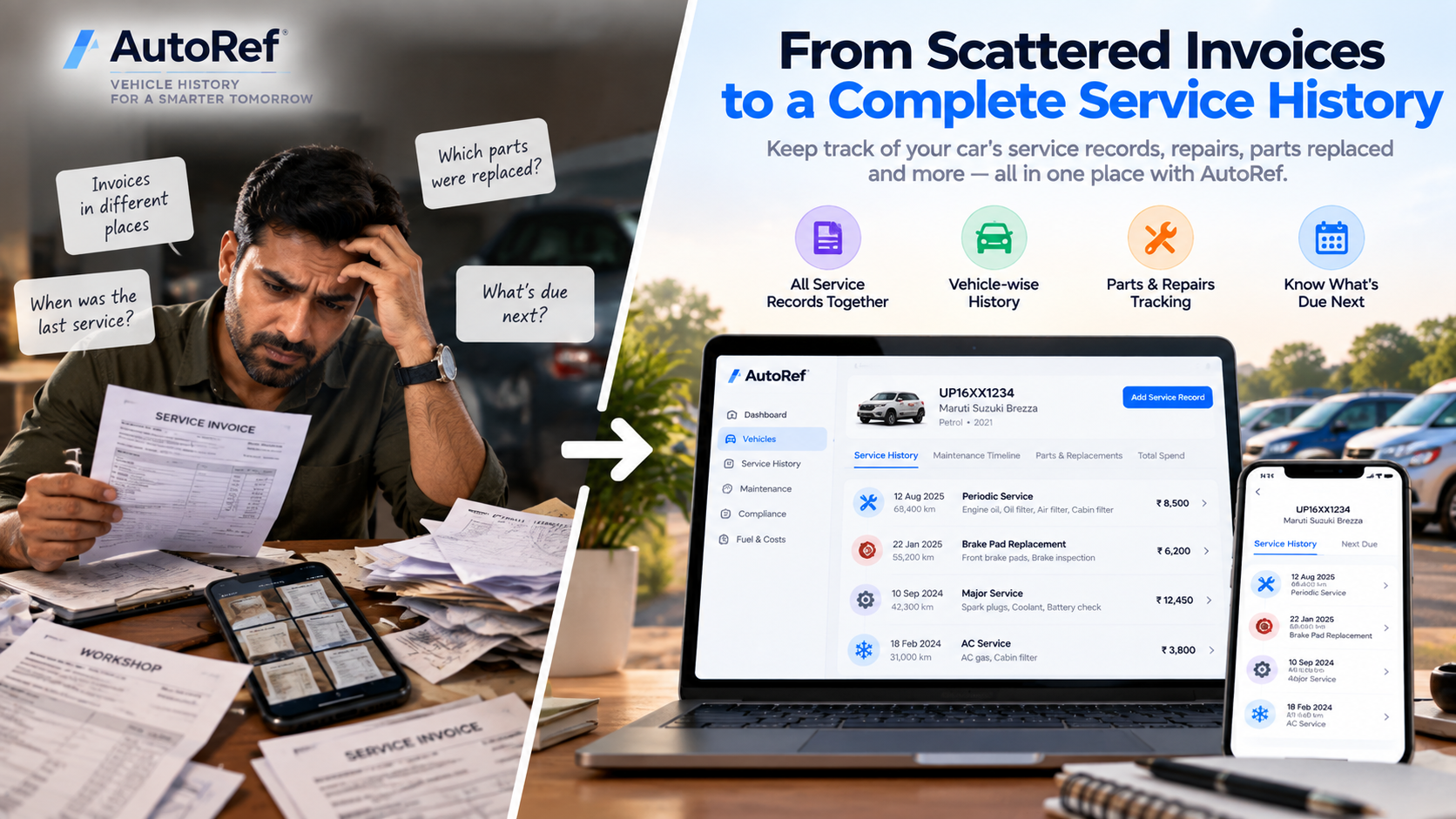 Car Service & Repair
How to Keep Track of Your Car Service History
Learn what to record in your car service history, how to organize invoices, log mileage and parts, and use records to plan maintenance with confidence.
 Vehicle Maintenance Records
How to Check Car Insurance Expiry Date Online
Learn how to check your car insurance expiry date online using your policy, insurer portal and mParivahan, and how to track expiry dates for multiple vehicles.
 Fleet Vehicle Downtime Management
How to Reduce Vehicle Downtime in a Fleet
Learn how to reduce fleet downtime through preventive maintenance, repair tracking, vehicle history and better prioritization of maintenance.