
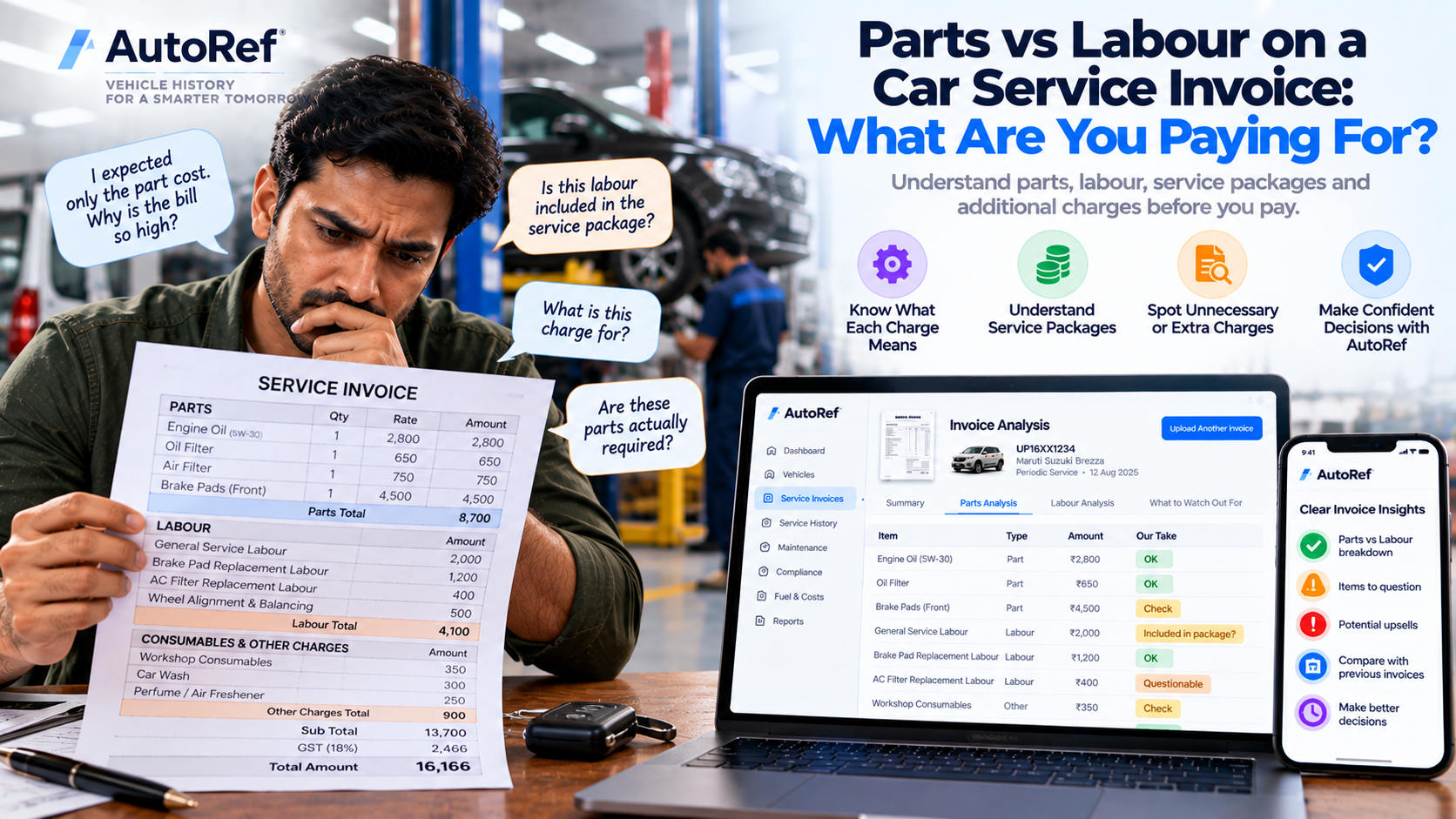
Introduction
When a car owner receives a service estimate, the first thing they often look at is the price of the parts.
Engine oil: ₹3,000.
Brake pads: ₹4,500.
Air filter: ₹700.
The numbers seem understandable.
Then the final invoice arrives, and the amount is considerably higher.
Where did the additional money come from?
In many cases, the difference is labour, service charges, consumables, taxes and additional jobs. Understanding this distinction is important because the actual cost of replacing a part is often:
Total replacement cost = Part cost + Labour cost + applicable taxes/other charges
For example, if brake pads cost ₹4,500 and the workshop charges ₹1,200 for the related labour, the cost associated with that replacement is ₹5,700 before applicable taxes.
What Charges Can Appear on a Service Invoice?
A typical car service invoice can contain several different types of charges:
- - Parts
- - Labour
- - Service/package charges
- - Consumables
- - Inspection or diagnosis
- - Cleaning
- - Wheel alignment/balancing
- - Washing
- - Additional repairs
- - Taxes
Not every invoice will contain all of these.
The important thing is to understand which charge relates to which job.
Why Labour Charges Often Surprise Car Owners
Consider a periodic service package priced at ₹2,500.
The owner may assume that because they have already paid for the service, the workshop will take care of all the basic work required during that visit.
But the final invoice may contain additional labour:
| Work | Parts | Labour |
|---|---|---|
| Periodic service | ₹2,800 | Included/package |
| Brake inspection/service | - | ₹600 |
| Wheel alignment | - | ₹500 |
| AC filter replacement | ₹700 | ₹200 |
The owner may therefore see a ₹2,500 service package but end up paying considerably more.
This is one of the frustrations reported by car owners: they pay a general service charge and then see separate labour charges for additional tasks.
The important question is not automatically whether those charges are wrong. It is:
Was this labour included in the service package, or was it an additional job?
Paid Service Packages Can Be Confusing
Many authorised workshops and service centres offer periodic service packages.
A package may include specific inspections, labour operations or routine maintenance items. But additional repairs or replacements may fall outside the package.
For example, a package could cover routine inspection and scheduled maintenance, while brake work, wheel alignment, AC-related work or replacement of a worn component may be billed separately.
This is why owners should ask:
"Which labour operations are included in the service package, and which ones will be charged separately?"
That one question can make the final invoice much easier to understand.
Bundled Labour Charges Create Another Problem
Sometimes labour is not shown against every individual part.
Instead, the invoice may contain a broader labour item such as:
General Service Labour – ₹2,000
or
Brake Service Labour – ₹1,200
This is a bundled labour charge.
Bundling is not inherently a problem. A workshop may legitimately charge a combined amount for a defined operation.
But the customer should still be able to understand what the charge covers.
If several parts appear on the invoice but one large labour amount is listed separately, this question helps connect the labour cost with the work actually performed.
The Customer Often Sees Parts, Not the Complete Cost
One common owner behaviour is to compare only part prices.
For example:
"The brake pad costs ₹4,500. Why is my bill ₹6,000?"
The missing ₹1,500 may be labour, taxes or another associated charge.
A better approach is to evaluate the complete job:
Brake pad replacement
→ Parts: ₹4,500
→ Labour: ₹1,200
→ Other applicable charges/tax: ₹X
→ Total job cost: ₹X
This gives you a much clearer understanding of what you are paying for.
The Problems Owners Commonly Face
Feedback from car owners highlights several recurring frustrations.
One owner said that service invoices should be explained in a much simpler way, rather than expecting customers to understand workshop terminology.
Another described being charged additional labour for tasks such as checking or servicing brakes after already paying a general service charge. The frustration was not necessarily the amount itself, but the lack of clarity about what the initial service charge covered.
Another owner described accessories such as perfume or air fresheners appearing on the final invoice. Because the service centre offered conveniences such as home delivery and digital payment, the customer paid quickly and did not examine the invoice closely.
Other concerns include:
- 1. Whether the replaced part was genuinely required
- 2. Whether the correct part was actually replaced
- 3. Whether the oil used was appropriate
- 4. Whether washing or cleaning charges were added
- 5. Whether consumables such as cloth, towel or perfume were billed
- 6. Whether a repair was already included in the paid service package
These are precisely the situations where a simple invoice explanation can make a difference.
How AutoRef Helps You Understand Parts and Labour
AutoRef analyses the line items in a service invoice and separates the information into understandable categories.
Instead of seeing:
LAB-R&R BRK ASSY – ₹1,850
an owner can get more context about the type of work represented by the line item and whether it requires further confirmation.
AutoRef's Engine can classify invoice items based on the available vehicle and service context into categories such as OK, CONFIRMATION_REQUIRED, QUESTIONABLE, JUSTIFICATION_REQUIRED and ATTENTION.
This is important because AutoRef does not simply label every unfamiliar charge as unnecessary.
For example, if a brake-related labour item appears, the useful question may be:
"What condition of the brake system required this work, and was this labour included in the service package?"
If the same component was recently replaced, the owner's question can become even more specific:
"This component appears in my previous service record. What has changed that requires it to be replaced again?"
That is the difference between looking at an invoice and using an invoice to make a decision.
What to Check Before Paying
Before making the final payment, check:
- 1. Parts: What was replaced and why?
- 2. Labour: What work does each labour charge cover?
- 3. Package: Which labour operations were already included?
- 4. Consumables: Which additional consumables were billed?
- 5. History: Was the same work recently performed?
- 6. Approval: Did you actually approve the additional work?
You do not need to understand every mechanical term.
You need enough information to ask the right question before approving the bill.
Conclusion
A car service invoice becomes much easier to understand when you separate parts, labour, package charges, consumables and additional work.
The price of a part is only one component of the final cost. Labour can be bundled, separately charged or partially included within a service package.
For individual car owners, the biggest challenge is often not the willingness to pay—it is knowing what they are paying for.
AutoRef helps by analysing service invoices, connecting the charges with the vehicle's history and using its Engine to identify items that may need confirmation, questioning or further justification.
The objective is simple: understand the bill first, then decide what to approve.
Frequently Asked Questions
Does AutoRef separate parts and labour on a service invoice?
Yes. AutoRef analyses invoice line items and helps organise the charges into parts, labour and other relevant categories so that owners can understand the structure of the bill.
Can AutoRef tell me whether labour is included in my service package?
AutoRef can identify and analyse the labour items appearing on the invoice. Whether a particular operation was contractually included in a workshop's service package may require confirmation from the service centre.
Can AutoRef identify charges that need to be questioned?
Yes. Its Decision Engine can classify relevant invoice items into categories such as CONFIRMATION_REQUIRED, QUESTIONABLE, JUSTIFICATION_REQUIRED and ATTENTION, based on the available vehicle and service context.
Can AutoRef compare a current invoice with previous work?
Yes. AutoRef keeps invoice information associated with the vehicle, allowing previous service and repair records to provide context when reviewing the current invoice.
Related Articles
All Car Maintenance & Upkeep →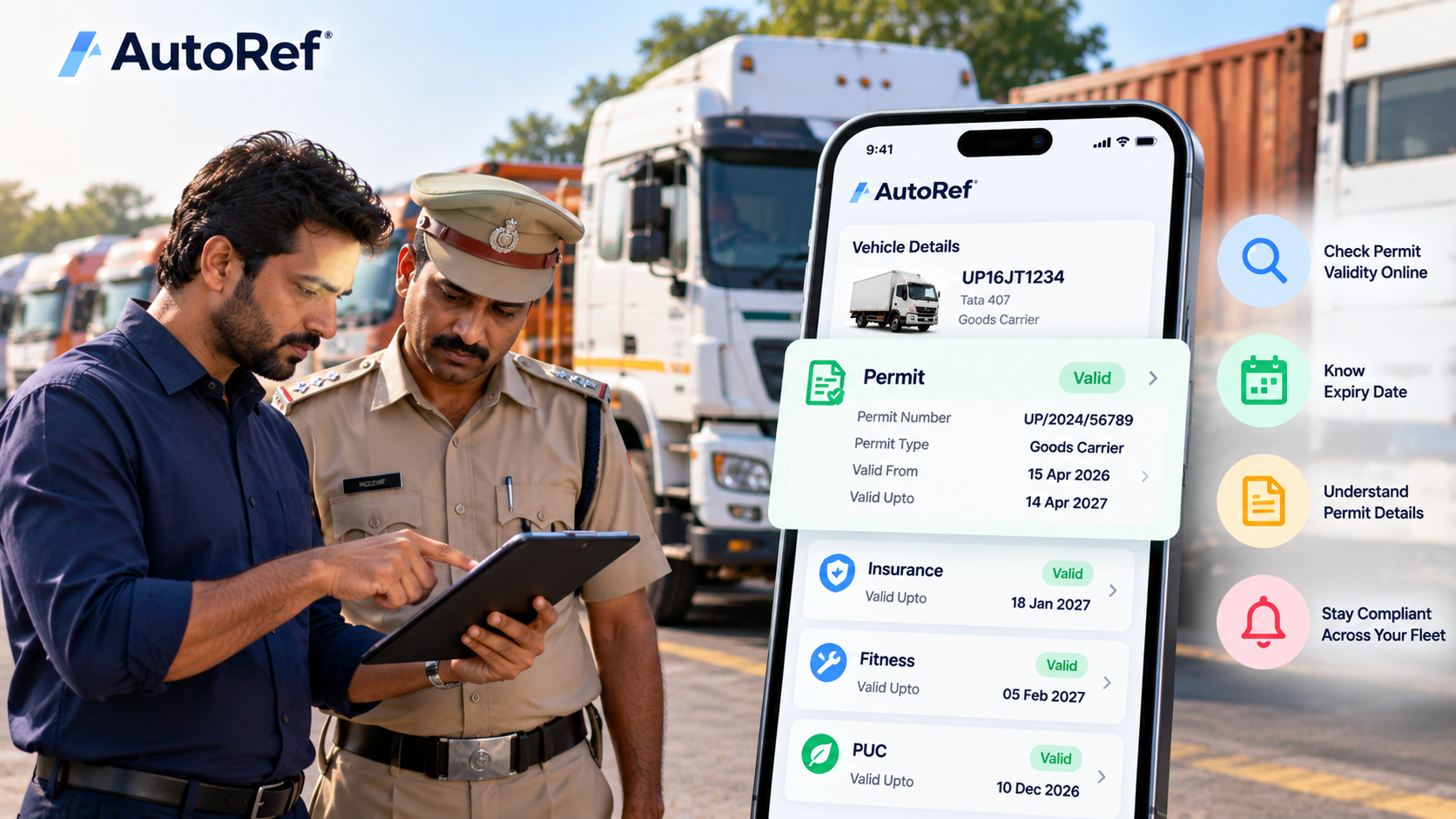 Car Maintenance & Upkeep
Commercial Vehicle Permit: How to Check Validity and Expiry
Commercial Vehicle Permit: Check Validity & Expiry
 Car Maintenance & Upkeep
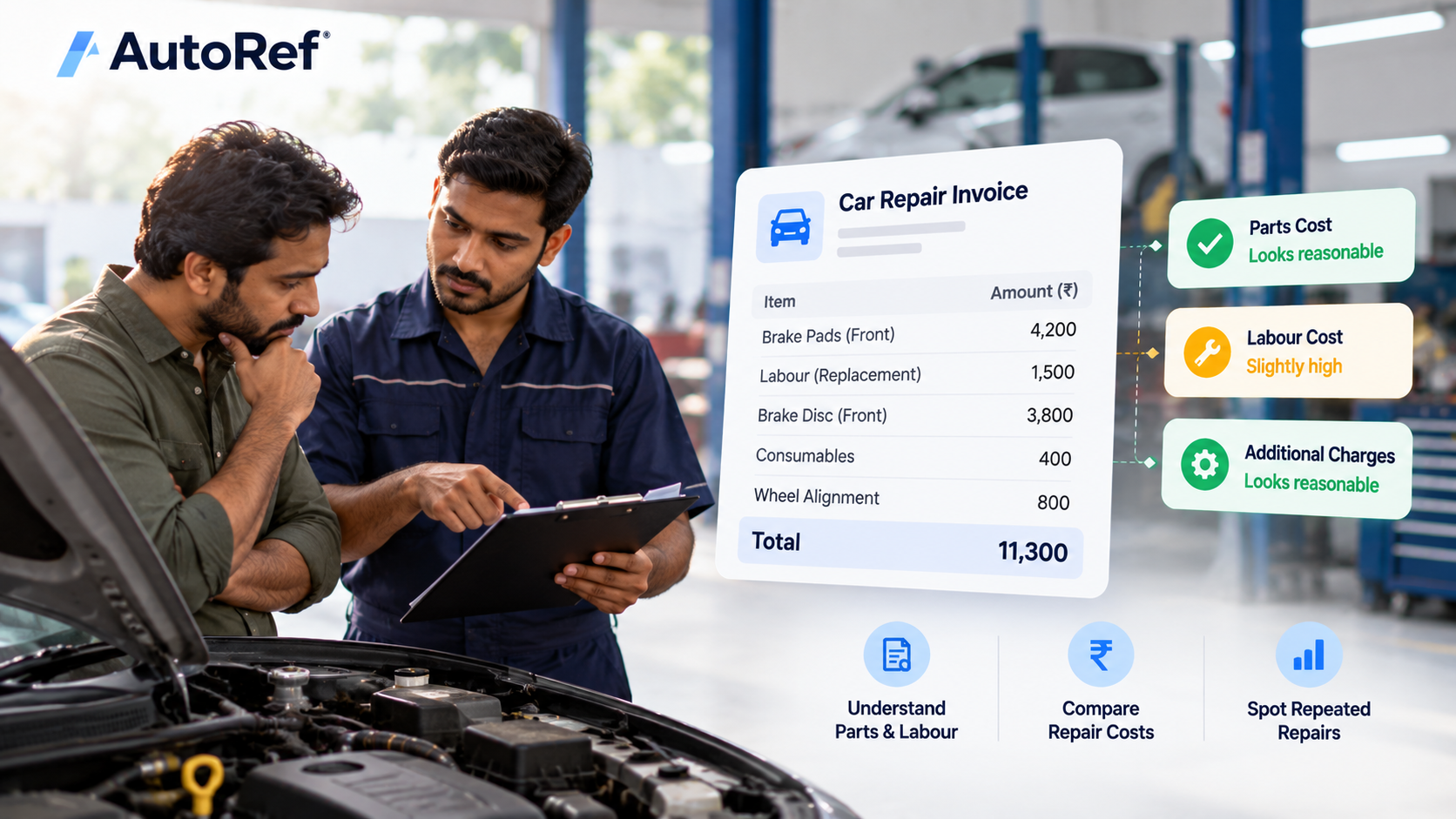
How to Check If a Car Repair Cost Is Reasonable
Learn how to check car repair costs, compare parts and labour, identify repeated repairs and evaluate repair bills for your car or fleet.
 Car Maintenance & Upkeep
Vehicle Compliance Checklist: RC, Insurance, PUC, Challans and Permits
Vehicle compliance checklist covering RC, insurance, PUC, challans and permits, with practical tips for individual owners and commercial fleets.