
Introduction
When should a vehicle be serviced?
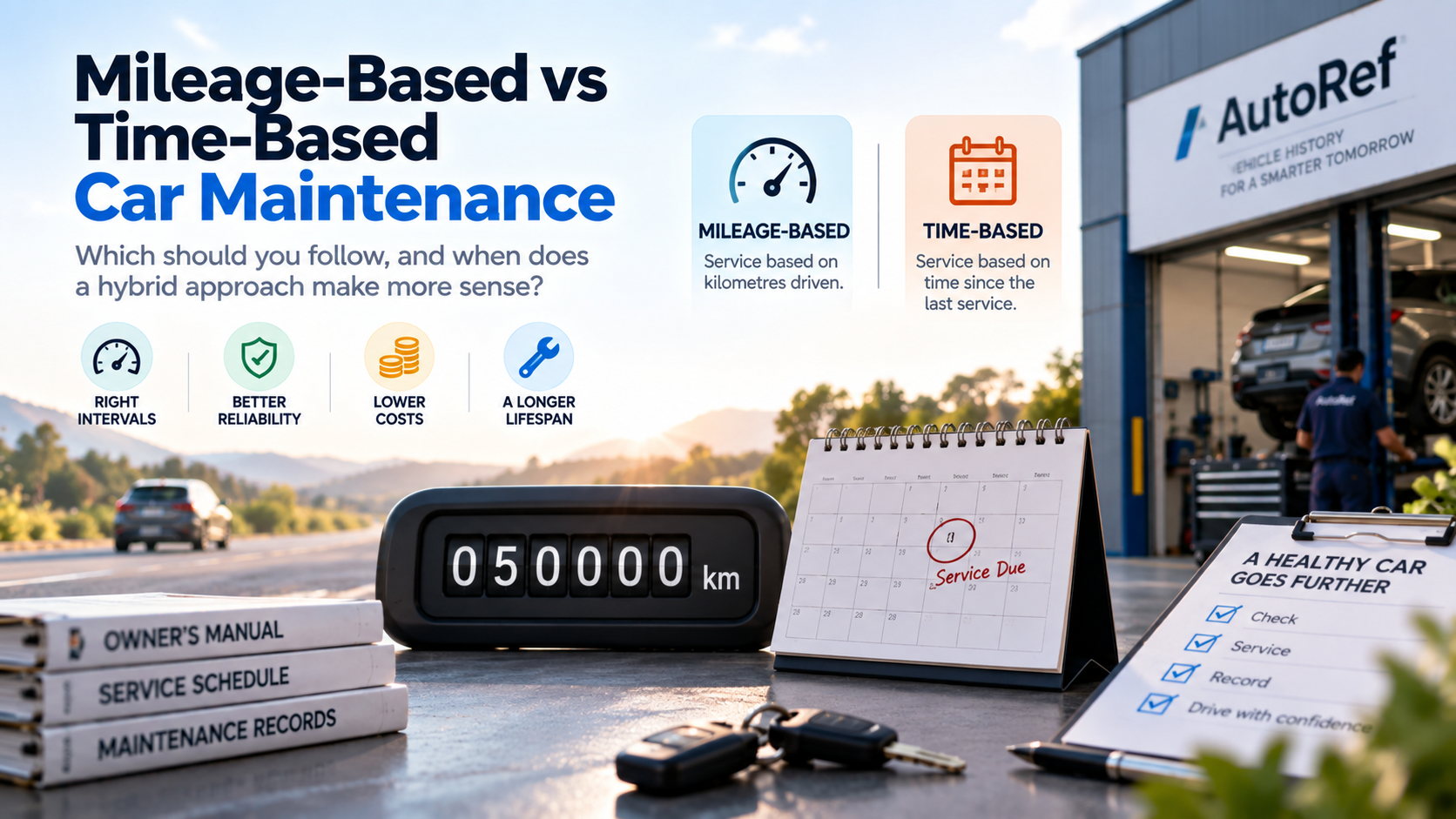
For many vehicle owners, the answer seems straightforward: follow the service interval recommended by the manufacturer. But service intervals are often expressed in two ways: time and mileage.
A vehicle might need servicing every 10,000 km or every 12 months, for example. But what happens if you drive only 5,000 km in a year? Or if you drive 30,000 km in six months?
This is where the difference between mileage-based maintenance and time-based maintenance becomes important.
Mileage helps account for how much a vehicle has been driven, while time matters because some maintenance requirements are affected by age, even when a vehicle is not driven frequently.
For most vehicles, the practical approach is not to choose one system exclusively. Instead, maintenance should consider mileage, time, vehicle usage, operating conditions, and maintenance history.
What Is Mileage-Based Maintenance?
Mileage-based maintenance uses the distance a vehicle has travelled to determine when certain maintenance tasks are due.
For example, a manufacturer's maintenance schedule may specify certain inspections, fluid changes, filter replacements, or other work at particular mileage intervals.
This approach is particularly useful when vehicles accumulate kilometres quickly.
A taxi, delivery vehicle, company car, or other heavily used vehicle may reach a service milestone much sooner than a privately owned vehicle that is driven occasionally.
Mileage-based maintenance therefore helps connect maintenance requirements with actual vehicle usage.
Common mileage milestones can include:
- - 10,000 km
- - 20,000 km
- - 30,000 km
- - 40,000 km
- - 50,000 km
- - Higher mileage intervals specified by the manufacturer
The exact work required at each interval varies by vehicle make, model, engine, transmission, usage and manufacturer recommendations.
What Is Time-Based Maintenance?
Time-based maintenance uses the age of the maintenance item or the time since the previous service as a trigger.
For example, a manufacturer may specify that a particular inspection or replacement should happen every 12 months, even if the vehicle has travelled relatively few kilometres.
This matters because not every maintenance requirement is directly proportional to distance travelled.
Some components, fluids, rubber parts and other items can deteriorate with age, storage conditions or environmental exposure.
Time-based maintenance is therefore particularly relevant for vehicles that:
- - Are driven infrequently
- - Spend long periods parked
- - Are used seasonally
- - Accumulate relatively low annual mileage
- - Operate in conditions where age-related deterioration matters
Mileage-Based vs Time-Based Maintenance
| Factor | Mileage-Based Maintenance | Time-Based Maintenance |
|---|---|---|
| Main trigger | Distance travelled | Time since service or replacement |
| Useful for | High-utilisation vehicles | Low-utilisation vehicles |
| Reflects vehicle usage | Strongly | Indirectly |
| Useful for age-related maintenance | Limited | Stronger |
| Typical example | Service at a mileage milestone | Service after a specified number of months |
| Main limitation | Can overlook age | Can overlook actual usage |
Neither approach is sufficient for every situation.
A vehicle that travels 30,000 km a year may reach mileage-based service intervals quickly, while a vehicle that travels only 5,000 km may need attention based on elapsed time.
When Mileage Matters More
Mileage becomes particularly important when a vehicle is used heavily.
Consider two vehicles that are both one year old:
- One vehicle has travelled 5,000 km.
- Another vehicle B has travelled 40,000 km.
Treating them identically simply because they are the same age would ignore a major difference in usage.
This is especially relevant for:
- - Taxi fleets
- - Corporate fleets
- - Rental vehicles
- - Delivery vehicles
- - High-mileage personal vehicles
For these vehicles, mileage should be tracked alongside the manufacturer's recommended service schedule.
When Time Matters More
The opposite situation can also occur.
Imagine a car that has travelled only 4,000 km in the past year. Its low mileage does not necessarily mean that every maintenance requirement can be postponed indefinitely.
Some maintenance requirements are based on elapsed time rather than kilometres.
This is why a vehicle maintenance schedule can contain both:
X kilometres OR X months, whichever comes first.
The exact interval should always be checked against the vehicle manufacturer's recommendations.
What About 30,000 Km, 40,000 Km and 50,000 Km Services?
Mileage-specific service questions are common because vehicle maintenance schedules often use kilometre milestones.
For example, owners may search for:
- - 30,000 km service checklist
- - 40,000 km service checklist
- - 50,000 km car service checklist
- - 50,000 km service
- - high-mileage vehicle maintenance
These milestones should not be treated as universal checklists.
A 40,000 km service for one vehicle may involve different inspections or replacements from another vehicle.
The correct approach is to start with the manufacturer's service schedule, then consider:
- - Current odometer reading
- - Time since the last service
- - Previous maintenance completed
- - Vehicle usage
- - Operating conditions
- - Known recurring issues
- - Current vehicle condition
This is particularly important for fleet operators managing vehicles with very different mileages.
Should You Follow Mileage or Time?
In most cases, the answer is both.
If the manufacturer specifies maintenance at a particular mileage or time interval, the relevant trigger should be followed rather than choosing whichever system appears more convenient.
A practical approach is:
Track mileage + track time + consider usage + check maintenance history.
For example:
A vehicle may be due for maintenance because it has reached its mileage threshold, while another vehicle with much lower mileage may still require maintenance because the recommended time interval has elapsed.
This hybrid approach provides a more complete view than relying on mileage or time alone.
Why Maintenance History Matters
A service schedule tells you when maintenance may be due.
Maintenance history tells you what has already happened to the vehicle.
That distinction becomes increasingly important as vehicles accumulate more service and repair work.
A useful vehicle maintenance record should help you answer questions such as:
- - When was the last service completed?
- - What work was performed?
- - Which parts were replaced?
- - What repairs have occurred previously?
- - Are there recurring problems?
- - How many kilometres had the vehicle travelled at the time?
- - What maintenance may be due next?
For fleet operators, this information becomes even more important because the fleet may contain vehicles of different ages, mileages and operating patterns.
Maintaining a connected vehicle service history makes it easier to use previous maintenance when making future decisions.
How AutoRef Helps Track Vehicle Maintenance
AutoRef helps bring vehicle service and repair information together at the vehicle level.
Instead of treating every workshop invoice as a separate document, AutoRef helps maintain a connected record of the vehicle's service and repair history.
This gives owners and fleet operators better context when reviewing maintenance — including what was previously serviced, what repairs were performed, and how the vehicle's history can inform future maintenance decisions.
The objective is not simply to follow a calendar. It is to build enough maintenance history and visibility to understand what each vehicle has already received and what may need attention next.
Conclusion
Mileage-based and time-based maintenance are not competing systems.
Mileage helps reflect how much a vehicle has been used, while time helps account for maintenance requirements that can arise even when a vehicle is driven relatively little.
For most vehicles, a practical maintenance approach combines:
- - Manufacturer recommendations
- - Mileage
- - Time since the previous service
- - Vehicle usage
- - Operating conditions
- - Vehicle condition
- - Maintenance history
The result is a maintenance schedule that reflects the vehicle rather than relying on a single trigger.
Frequently Asked Questions
Is mileage or time more important for car maintenance?
Both can matter. Follow the manufacturer's recommended mileage and time intervals and use the relevant trigger specified for each maintenance item.
What happens if I don't drive my car very much?
Low mileage does not necessarily mean maintenance can be postponed indefinitely. Some maintenance requirements are time-based, so check the manufacturer's recommended intervals even if the vehicle is driven infrequently.
Should high-mileage vehicles be serviced more frequently?
High-utilisation vehicles may reach mileage-based maintenance intervals sooner and can experience more wear from frequent use. Their maintenance should therefore be tracked according to the manufacturer's schedule while also considering usage and vehicle condition.
Related Articles
All Fleet Maintenance Management → Fleet Maintenance Management
How to Prioritise Maintenance Across a Large Vehicle Fleet
Learn how to prioritise fleet maintenance using safety, breakdown risk, vehicle utilisation, maintenance history, and operational impact.
 Fleet Maintenance Management
10 Essential Tasks for a Fleet Preventive Maintenance Checklist
Use this fleet preventive maintenance checklist to inspect fluids, tyres, brakes, battery, lights, leaks, and records to cut downtime and costs.
 Fleet Maintenance Management
What Causes Preventive Maintenance Programs to Fail?
What Causes Preventive Maintenance Programs to Fail?