
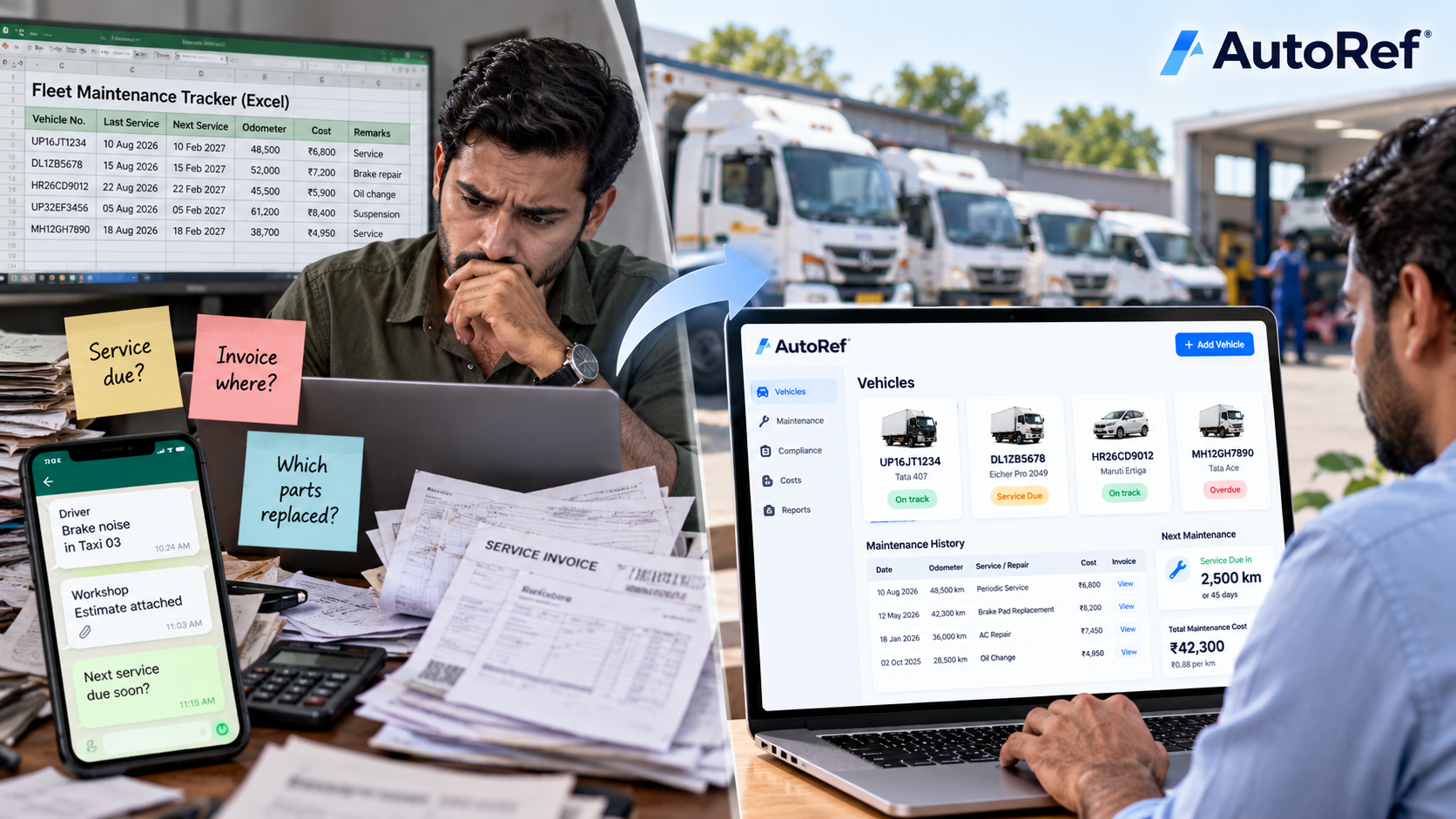
Managing maintenance for one vehicle is relatively simple. Managing it for 5, 10 or 30 vehicles is different.
A fleet owner may have service invoices with one workshop, repair bills with another, mileage updates from drivers and maintenance information sitting in an Excel sheet. Over time, it becomes difficult to answer basic questions:
- - When was this vehicle last serviced?
- - What was replaced during the previous service?
- - How much has this vehicle cost to maintain?
- - Which vehicles are due for maintenance?
- - Is the same repair happening repeatedly?
- - Which garage has worked on the vehicle before?
This is where fleet maintenance tracking becomes important.
A good maintenance tracking system connects each vehicle with its service history, repairs, parts, invoices and maintenance costs.
What Is Fleet Maintenance Tracking?
Fleet maintenance tracking is the process of recording and monitoring the maintenance activity of every vehicle in a fleet.
This can include:
- - Service dates
- - Odometer readings
- - Service type
- - Parts replaced
- - Repairs performed
- - Labour charges
- - Maintenance invoices
- - Workshop or garage
- - Maintenance costs
- - Previous repairs
- - Upcoming maintenance requirements
The objective is not simply to maintain a list of service dates.
The real value comes from being able to look at a vehicle's complete maintenance history when making the next maintenance decision.
Why Fleet Maintenance Becomes Difficult With Spreadsheets
A spreadsheet can work reasonably well when you have a few vehicles and limited maintenance activity.
For example:
| Vehicle | Last Service | Odometer | Cost |
|---|---|---|---|
| Taxi 01 | 10 Aug | 48,000 km | ₹6,800 |
| Taxi 02 | 15 Aug | 52,000 km | ₹7,200 |
| Taxi 03 | 22 Aug | 45,500 km | ₹5,900 |
But this is only the beginning.
As the fleet grows, you may need additional columns for:
- - Brake repairs
- - Tyre replacement
- - Battery replacement
- - Insurance
- - PUC
- - Workshop
- - Invoice number
- - Parts
- - Labour
- - Repair history
- - Next service
- - Driver
- - Cost per kilometre
The spreadsheet becomes increasingly difficult to maintain.
There is another problem: the information is often not actually in the spreadsheet.
The invoice may be in WhatsApp.
The driver's complaint may be in a phone call.
The workshop estimate may be in an email.
The previous repair may exist only on a paper bill.
The result is a fragmented maintenance history.
What Should You Track for Every Fleet Vehicle?
A useful fleet maintenance tracking system should maintain a vehicle-level record.
1. Vehicle information
Record:
- - Registration number
- - Make and model
- - Fuel or powertrain
- - Vehicle type
- - Current odometer
2. Service history
Track:
- - Service date
- - Odometer at service
- - Type of service
- - Work performed
- - Parts replaced
- - Workshop
- - Invoice
3. Repair history
Record significant repairs separately from routine servicing.
For example:
- - Brake repair
- - Suspension work
- - AC repair
- - Battery replacement
- - Clutch work
- - Cooling-system repair
- - Electrical repair
4. Maintenance cost
Track how much each vehicle costs to maintain.
Over time, you can calculate:
Maintenance cost per kilometre = Total maintenance cost ÷ Kilometres driven
This makes it easier to compare vehicles that have different levels of utilisation.
Why Vehicle-Level Maintenance History Matters
Consider two vehicles in the same fleet.
Vehicle A
- - 60,000 km
- - Regular servicing
- - ₹42,000 maintenance spend
- - No major recurring repairs
Vehicle B
- - 60,000 km
- - ₹67,000 maintenance spend
- - Three suspension repairs
- - Two battery replacements
- - Multiple workshop visits
Looking only at the current service requirement would hide the difference.
Looking at the vehicle maintenance records shows that Vehicle B may need further investigation.
The higher cost does not automatically mean something is wrong. It could be an older vehicle, have different operating conditions or have experienced a major repair.
The value of tracking is that it allows the fleet manager to identify the difference and investigate it.
Track Maintenance by Odometer, Not Just Date
A common mistake is recording only:
|“Next service: October”
Fleet vehicles can accumulate very different mileage in the same period.
For example:
| Vehicle | Monthly mileage |
|---|---|
| Taxi 01 | 4,500 km |
| Taxi 02 | 2,000 km |
| Taxi 03 | 800 km |
All three may have been serviced in the same month, but their next maintenance requirements can arrive at very different times.
Therefore, fleet maintenance tracking should combine:
Date + Odometer + Manufacturer schedule + Vehicle usage
The manufacturer's recommended maintenance schedule should remain the primary reference for service intervals.
For more detail, see How Often Should Fleet Vehicles Be Serviced?.
Don't Track Only Scheduled Maintenance
A fleet maintenance tracker should also capture unplanned repairs.
Suppose a driver reports brake noise at 42,000 km.
The vehicle goes to a workshop and the brake pads are replaced.
If that repair is not recorded, the next fleet manager may not know that the brake pads were recently replaced.
Six months later, the same vehicle may generate another brake-related recommendation.
A proper maintenance history makes the previous work visible.
The maintenance process becomes:
Problem reported → Inspection → Repair → Invoice → Record updated
rather than:
Problem reported → Repair → Invoice disappears into a folder
Use Maintenance History to Identify Recurring Repairs
Maintenance tracking becomes particularly useful when you look across several service events.
For example:
| Vehicle | Repair | Occurrences |
|---|---|---|
| Taxi 01 | Brake work | 1 |
| Taxi 02 | Brake work | 3 |
| Taxi 03 | Brake work | 1 |
| Taxi 04 | Brake work | 2 |
Taxi 02 deserves a closer look.
Possible explanations could include:
- - High mileage
- - Heavy city usage
- - Driving conditions
- - Component quality
- - A related mechanical issue
- - Normal wear
The data does not tell you the answer automatically.
It tells you where to investigate.
Track Maintenance Costs Across Vehicles
A fleet manager should not look only at the total workshop bill.
Consider:
| Vehicle | Maintenance spend | Km driven | Maintenance cost/km |
|---|---|---|---|
| Taxi 01 | ₹42,000 | 48,000 | ₹0.88 |
| Taxi 02 | ₹68,000 | 52,000 | ₹1.31 |
| Taxi 03 | ₹39,000 | 46,000 | ₹0.85 |
Vehicle 02 has the highest maintenance cost per kilometre.
That does not automatically make it the worst vehicle.
The fleet manager should investigate:
- - What repairs caused the additional spend?
- - Was there an accident?
- - Are repairs recurring?
- - Is the vehicle older?
- - Is it operating under more demanding conditions?
This is where maintenance tracking becomes a management tool rather than just record keeping.
Fleet Maintenance Tracking vs a Spreadsheet
A spreadsheet is essentially a table.
A proper maintenance tracking system should connect information around the vehicle.
| Spreadsheet approach | Vehicle-based tracking |
|---|---|
| Service entered as a row | Service linked to vehicle |
| Invoice stored separately | Invoice connected to maintenance event |
| Repairs manually searched | Vehicle history available together |
| Costs calculated separately | Vehicle maintenance costs can be reviewed |
| Difficult to compare history | Previous work is easier to review |
| Information often duplicated | One vehicle record becomes the reference |
For a very small fleet, a spreadsheet may still be sufficient.
The problem begins when the fleet owner needs to maintain history, invoices, repairs and costs together across multiple vehicles.
What About Fleet Maintenance Software?
This is where fleet maintenance software can be useful.
Instead of maintaining multiple spreadsheets, operators can use a system designed around vehicles and maintenance events.
For a small fleet, the most useful capabilities are not necessarily complicated workshop-management functions.
They are often simple things such as:
- - Vehicle-level maintenance history
- - Service and repair records
- - Invoice storage
- - Parts and labour information
- - Maintenance cost tracking
- - Odometer history
- - Searchable records
- - Multiple-vehicle visibility
The right solution depends on the size and complexity of the fleet.
A 5-vehicle owner does not necessarily need the same system as a 500-vehicle transport company.
How to Track Fleet Maintenance Without Spreadsheets
A practical workflow can look like this:
Step 1: Add every vehicle
Create one record for each vehicle.
Step 2: Record the current odometer
This provides a baseline for future maintenance tracking.
Step 3: Add previous service history
Where available, add historical service and repair information.
Step 4: Record every service and repair
Do not record only major services. Significant repairs and component replacements should also become part of the vehicle history.
Step 5: Store invoices with the maintenance event
This makes it easier to understand what was actually charged.
Step 6: Track maintenance costs
Compare total spend and cost per kilometre across vehicles.
Step 7: Review recurring problems
Look for vehicles generating repeated repairs or unusually high costs.
Step 8: Use the history for the next decision
Before approving significant work, check what was already done on the vehicle.
How AutoRef Helps With Fleet Maintenance Tracking
AutoRef is designed around the vehicle rather than the spreadsheet.
Fleet owners can maintain service and repair history for individual vehicles, including invoices and maintenance information.
Instead of searching through multiple files, the workflow becomes:
Vehicle → Service history → Repair history → Invoice → Cost → Previous work
This can help fleet owners understand:
- - What was done previously
- - Which parts were replaced
- - How much was spent
- - Which repairs are recurring
- What the vehicle's maintenance pattern looks like
AutoRef can also analyse service and repair invoices to help owners understand parts, labour and additional charges.
The analysis is intended to highlight items that may require confirmation or justification. A flagged item is not automatically proof that a workshop has overcharged the owner.
For fleet operators, this creates a more complete maintenance record that can be used alongside their existing maintenance process.
Small Fleet Owners Have the Same Problem
You don't need 100 vehicles for maintenance tracking to become difficult.
A small operator with 5–10 taxis, delivery vehicles or commercial cars may have:
- - Multiple drivers
- - Multiple workshops
- - Different service dates
- - Different mileage
- - Different repair histories
- - Multiple invoices
The challenge is not fleet size alone.
It is the number of maintenance events and information sources that accumulate over time.
This is why a small fleet can benefit from structured vehicle maintenance tracking even before maintenance becomes a large administrative function.
From Maintenance Records to Better Fleet Decisions
Once maintenance information is consistently recorded, it can support decisions beyond the next service.
You can start asking:
- - Which vehicles have the highest maintenance cost?
- - Which vehicles have recurring repairs?
- - Which vehicles visit workshops most frequently?
- - Which parts are being replaced repeatedly?
- - Which vehicles may require closer monitoring?
- - How is maintenance cost changing over time?
This turns maintenance history into operational information.
The objective is not to eliminate every repair.
It is to make maintenance decisions with better information.
Conclusion
Tracking fleet maintenance without spreadsheets is ultimately about creating a reliable vehicle-level history.
A useful system should connect service records, repairs, parts, invoices, mileage and maintenance costs to individual vehicles.
For a very small fleet, a spreadsheet may be enough initially. But as vehicles and maintenance events increase, scattered spreadsheets, invoices and messages make it increasingly difficult to understand what has happened to each vehicle.
A structured fleet maintenance tracking system gives the operator a clearer answer to one important question:
|“What has happened to this vehicle, and what should I consider before approving its next maintenance?”
That history can help fleet owners control maintenance costs, identify recurring repairs and make better-informed decisions.
Frequently Asked Questions
How can I track fleet vehicle maintenance?
Track each vehicle's service dates, odometer readings, repairs, parts replaced, invoices and maintenance costs in a vehicle-level maintenance record. AutoRef helps organise this information around individual vehicles.
Is Excel good for fleet maintenance tracking?
Excel can work for a small fleet with simple requirements. As the number of vehicles, repairs, invoices and maintenance events increases, a dedicated vehicle maintenance tracking system can make records easier to organise and review.
What should a fleet maintenance tracker include?
A useful tracker should include vehicle details, service history, odometer readings, repairs, parts replaced, invoices, maintenance costs and previous work.
Can AutoRef track maintenance for multiple vehicles?
Yes. AutoRef allows service and repair information to be maintained at the individual vehicle level, making it possible to review maintenance history across multiple vehicles.
Can AutoRef analyse fleet maintenance invoices?
AutoRef can analyse service and repair invoices and provide context around parts, labour and additional charges. It can highlight items that may need confirmation or justification rather than automatically declaring a charge incorrect.
How does maintenance history help fleet owners?
Maintenance history helps fleet owners see previous work, identify recurring repairs, compare maintenance costs and understand the maintenance pattern of individual vehicles.
Related Articles
All Car Service & Repair →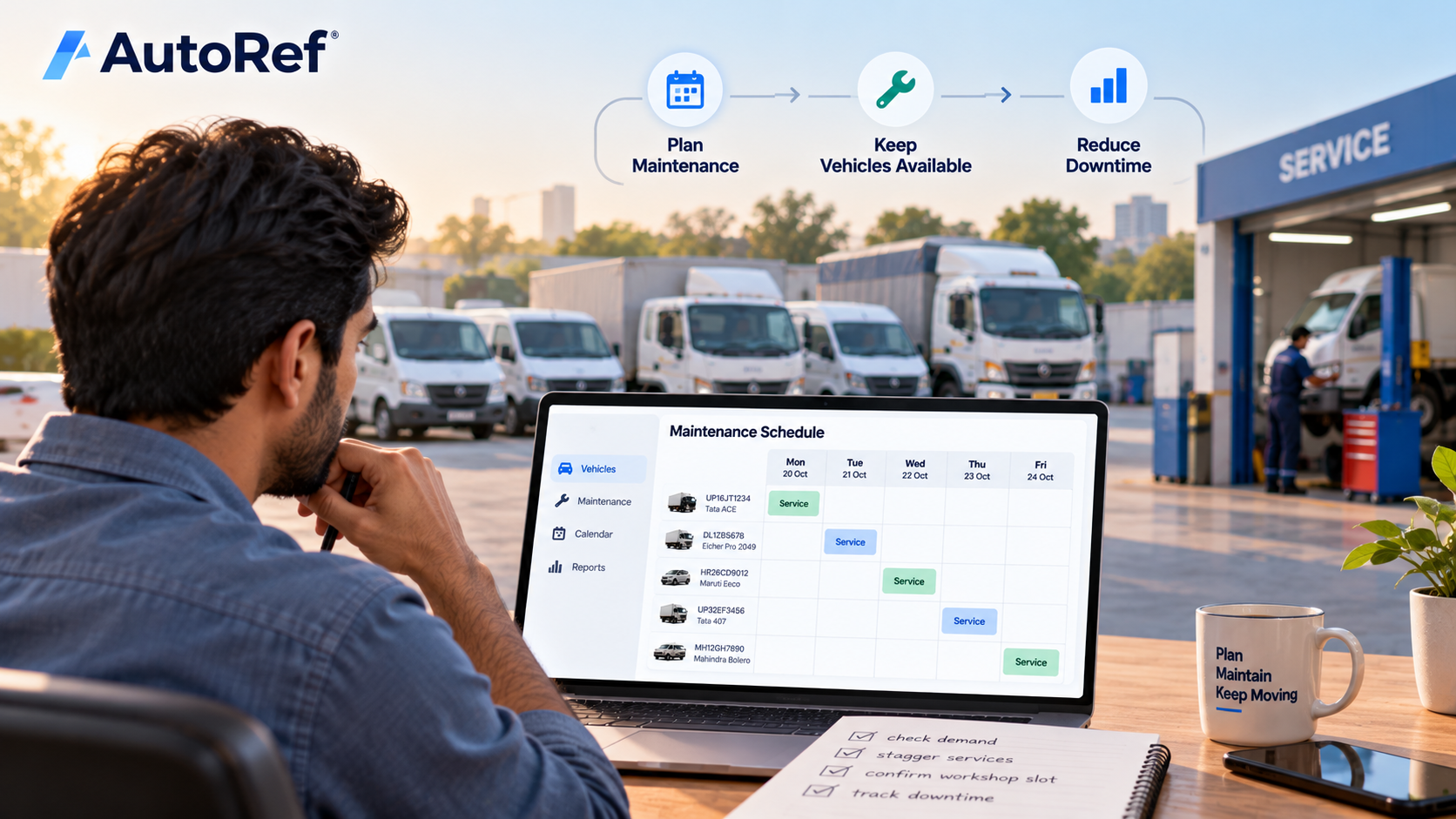 Car Service & Repair
How to Schedule Fleet Vehicle Maintenance Without Disrupting Operations
Learn to schedule fleet vehicle maintenance using a sample fleet plan, downtime calculations and KPIs to protect vehicle availability.
 Car Service & Repair
30,000 Km Car Service Checklist: What Should You Check?
Use this 30,000 km car service checklist to understand common parts, inspections, service costs, common problems and what to check before paying.
 Car Service & Repair
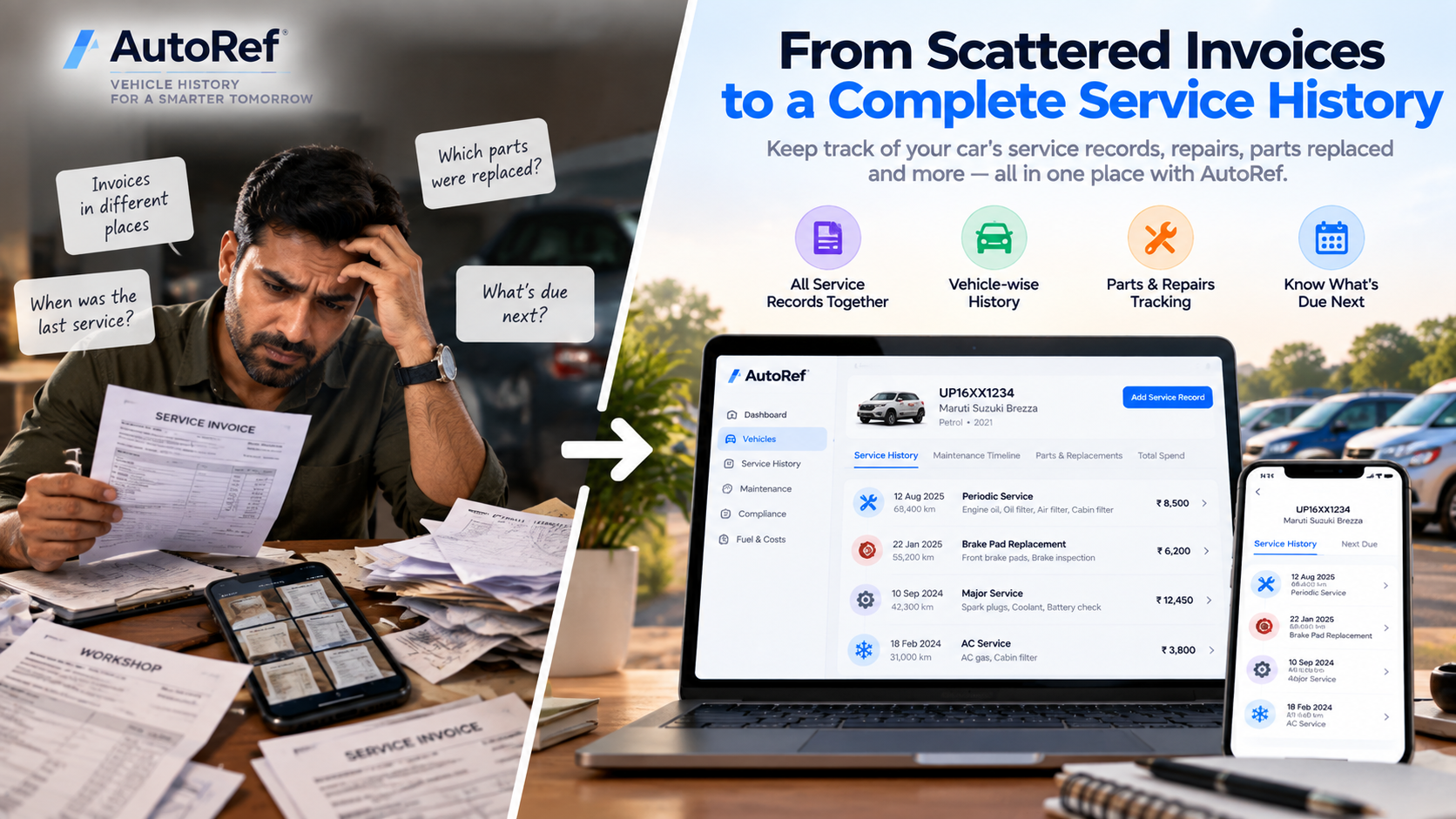
How to Keep Track of Your Car Service History
Learn what to record in your car service history, how to organize invoices, log mileage and parts, and use records to plan maintenance with confidence.