
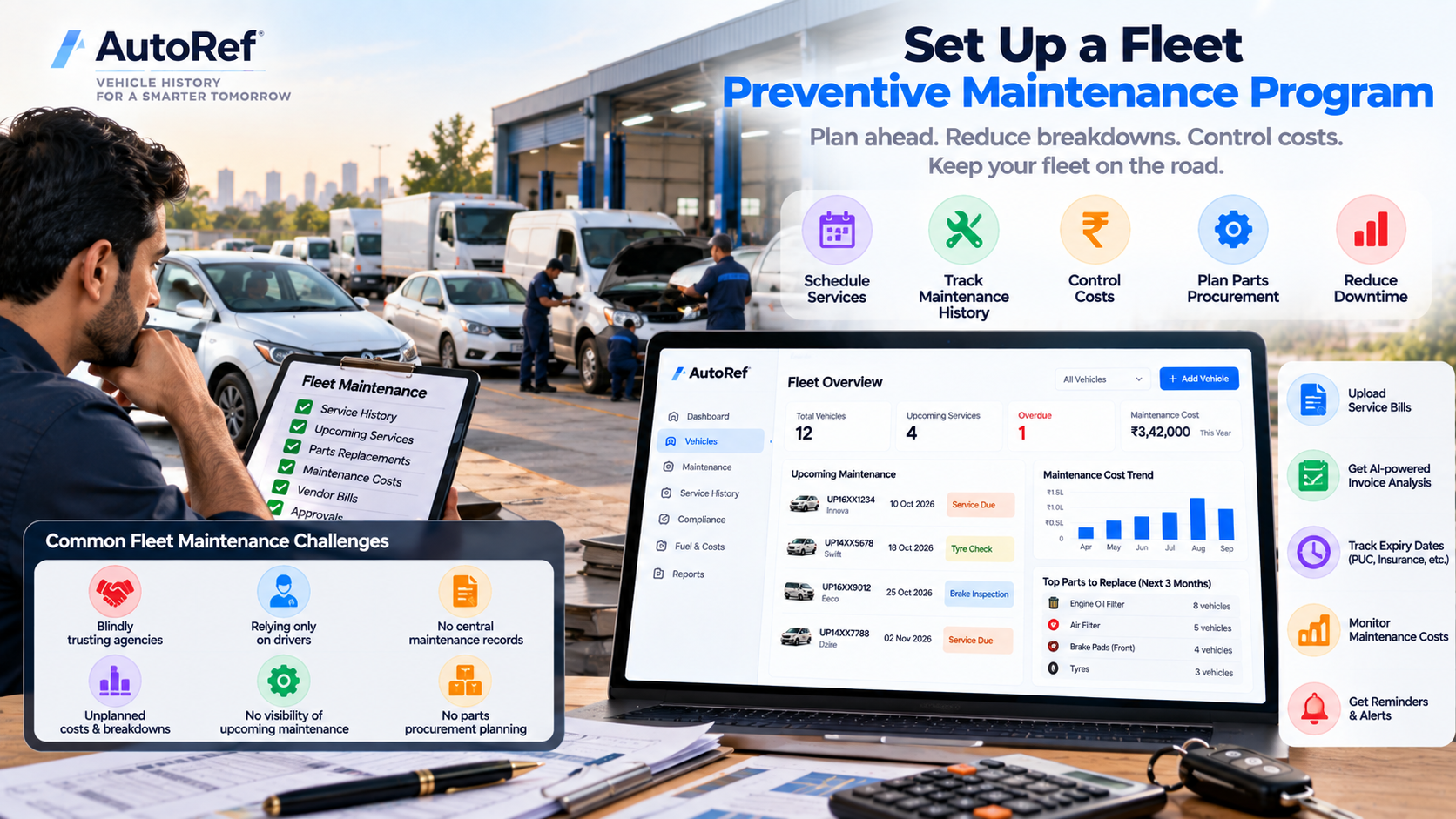
Introduction
A fleet preventive maintenance program is more than a list of service dates.
A proper program defines how maintenance decisions are made, who is responsible, what information is recorded and how the fleet learns from previous repairs.
For a small fleet, maintenance may be managed through drivers, workshop calls and paper invoices. As the number of vehicles increases, this approach becomes difficult to control.
The owner may start asking:
- Which vehicles are due for maintenance?
- What work was already done on each vehicle?
- Which vehicles are costing more to maintain?
- Are the same parts being replaced repeatedly?
- Which repairs should be investigated before approval?
- How much maintenance will the fleet require over the next few months?
A fleet preventive maintenance program creates a repeatable process for answering these questions.
What Is a Fleet Preventive Maintenance Program?
A fleet preventive maintenance program is a structured system for maintaining vehicles before avoidable failures become larger operational problems.
It typically combines:
- Manufacturer maintenance requirements
- Vehicle mileage and age
- Operating conditions
- Routine inspections
- Service and repair history
- Parts replacement records
- Maintenance costs
- Driver-reported problems
- Workshop records
- Compliance requirements
Fleet maintenance guidance commonly recommends combining regular inspections, mileage or usage-based service intervals, OEM maintenance requirements and consistent record-keeping.
The important distinction is that a program defines the complete operating process. A maintenance schedule is only one component of that program.
1. Start With a Complete Vehicle Register
Before creating maintenance rules, know exactly what is in the fleet.
For every vehicle, record:
- Registration number
- Make and model
- Manufacturing year
- Fuel/powertrain
- Current odometer
- Vehicle type
- Service provider
- Last service
- Previous repairs
- Major parts replaced
For example, a 15-vehicle fleet might contain:
- 8 petrol cars
- 4 diesel commercial vehicles
- 3 CNG vehicles
These vehicles should not automatically receive identical maintenance treatment.
The vehicle register becomes the foundation for everything that follows.
2. Establish the Maintenance Rules
Next, define the rules that determine when maintenance should happen.
Use the vehicle manufacturer's recommendations as the baseline, then account for:
Manufacturer schedule + mileage + time + operating conditions + vehicle history
For example, a vehicle used for:
- Frequent city driving
- High daily mileage
- Multiple shifts
- Heavy passenger/cargo loads
- Poor road conditions
may require closer monitoring than a similar vehicle used occasionally.
Do not create arbitrary fleet-wide rules such as “service every 10,000 km” without checking the manufacturer's requirements for the specific vehicle.
For a deeper discussion of service intervals, see [How Often Should Fleet Vehicles Be Serviced?].
3. Separate Scheduled Maintenance From Reported Problems
A good program should handle two different situations.
Scheduled maintenance
Examples:
- Periodic servicing
- Oil and filter replacement
- Manufacturer-recommended inspections
- Scheduled fluid checks
- Component inspections
Unplanned maintenance
Examples:
- Brake noise
- Battery failure
- Suspension problems
- AC failure
- Warning lights
- Tyre damage
- Engine or transmission problems
A vehicle should not be considered healthy simply because it is not yet due for its next scheduled service.
A driver-reported problem should enter the maintenance process immediately.
4. Create a Standard Inspection Process
The next step is to decide what gets checked and when.
Depending on the fleet, this could include:
Daily or pre-trip checks
-
Tyres
-
Lights
-
Brakes
-
Warning indicators
-
Visible leaks
-
Vehicle damage
Periodic inspections
-
Fluids
-
Battery
-
Brakes
-
Suspension
-
Filters
-
Belts and hoses
-
Cooling system
-
Tyre wear
The exact checklist should be adapted to the vehicle type and manufacturer's recommendations.
The purpose is consistency.
If five drivers inspect vehicles differently, the fleet manager receives five different standards of information.
5. Make Vehicle History Part of Every Maintenance Decision
This is one of the most important parts of the program.
Before approving significant maintenance, look at what happened previously.
Consider a fleet vehicle with:
- 72,000 km
- Two previous suspension repairs
- Three brake-related invoices
- One recent battery replacement
When the same vehicle develops another suspension complaint, the previous history provides useful context.
It does not automatically prove that another repair is unnecessary.
Instead, it allows the fleet owner to ask better questions:
What failed this time?
When was this component previously replaced?
What inspection finding supports the repair?
Is the same problem recurring?
This is why maintenance records are not just documentation. They become part of the decision-making process.
6. Create a Repair Approval Process
Fleet owners often face a visibility problem when vehicles are maintained by external workshops.
A driver may report:
“Garage ne suspension ka kaam bola hai.”
The owner may have limited information before approving the expense.
A simple approval process can be:
Vehicle history → Inspection/diagnosis → Estimate or invoice → Review → Approval → Completed work recorded
For higher-value repairs, require supporting information before approval.
This is particularly useful when vehicles operate in different cities or visit multiple workshops.
7. Track Maintenance Cost by Vehicle
Do not evaluate fleet maintenance only from the total annual workshop bill.
Track spending at the vehicle level.
For example:
| Vehicle | Annual maintenance | Km driven | Maintenance cost/km |
|---|---|---|---|
| Taxi 01 | ₹42,000 | 48,000 | ₹0.88 |
| Taxi 02 | ₹68,000 | 52,000 | ₹1.31 |
| Taxi 03 | ₹39,000 | 46,000 | ₹0.85 |
Taxi 02 deserves investigation because its maintenance cost per kilometre is substantially higher than the other vehicles.
But the number itself is not a diagnosis.
Possible explanations could include:
- Older vehicle
- Higher utilisation
- Accident repairs
- Repeated component failures
- Different operating conditions
- Major one-time repair
The purpose of the metric is to identify where the fleet manager should investigate.
8. Identify Repeated Repairs
A preventive maintenance program should learn from completed maintenance.
Look for patterns such as:
- Same component replaced repeatedly
- Same vehicle visiting the workshop frequently
- Increasing repair costs
- Repeated electrical problems
- Recurring brake or suspension work
- Multiple repairs shortly after previous work
For example:
Vehicle 07
| Repair | Occurrences |
|---|---|
| Battery | 2 |
| Suspension | 3 |
| Brake pads | 3 |
| AC repair | 2 |
That pattern warrants investigation.
The goal is not to assume that repeated work is incorrect. The goal is to determine why the same vehicle keeps generating the same maintenance requirement.
9. Plan Parts and Workshop Requirements
Historical records can also help with planning.
Suppose a 20-vehicle fleet has several vehicles approaching major service intervals.
Previous records show that the fleet commonly uses:
- Oil filters
- Air filters
- Cabin filters
- Brake pads
- Belts
- Batteries
The fleet manager can discuss expected requirements with the workshop in advance.
This can help reduce last-minute procurement and make workshop planning easier.
However, parts should not be replaced merely because a vehicle has reached a particular mileage. Actual inspection and the applicable manufacturer schedule should determine replacement.
10. Review the Fleet Every Month
A preventive maintenance program should have a recurring management review.
At minimum, review:
Maintenance status
-
Vehicles serviced
-
Vehicles approaching service
-
Overdue maintenance
-
Open repairs
Cost
-
Maintenance spend by vehicle
-
Maintenance cost/km
-
High-cost vehicles
-
Major repair expenditure
Reliability
-
Repeated repairs
-
Breakdown events
-
Vehicles frequently entering workshops
-
Recurring component failures
Planning
-
Upcoming service requirements
-
Expected parts requirements
-
Vehicles requiring inspection
-
Workshop capacity
This converts maintenance from a series of individual workshop visits into an ongoing fleet management process.
Fleet Preventive Maintenance Program vs Maintenance Schedule
These terms are related but not identical.
Preventive maintenance program
Defines:
- Maintenance policies
- Responsibilities
- Inspection process
- Service rules
- Repair approval
- Record keeping
- Cost tracking
- Review process
Preventive maintenance schedule
Defines:
- Which vehicle
- Which maintenance task
- When it is due
- Who will perform it
Your maintenance schedule is therefore one component of the larger preventive maintenance program.
For the scheduling process itself, see [How to Create a Preventive Maintenance Schedule for Your Fleet].
How AutoRef Supports a Fleet Preventive Maintenance Program
AutoRef can act as the vehicle-level maintenance record behind this process.
Instead of keeping information across:
- Paper invoices
- WhatsApp conversations
- Spreadsheets
- Different workshop records
- Driver messages
fleet owners can maintain service and repair history against individual vehicles.
AutoRef allows fleet managers to build a history of:
- Services
- Repairs
- Parts replaced
- Service invoices
- Maintenance costs
- Previous work
The history can then be reviewed before approving future maintenance.
AutoRef's invoice analysis can also help the owner understand parts, labour and additional charges on service or repair invoices. It is intended to provide context for questions and review—not automatically declare that a workshop charge is wrong.
Example: A 10-Vehicle Taxi Fleet
Consider a fleet of 10 taxis.
Without a structured program:
Driver reports problem → Workshop recommends work → Owner approves → Bill paid
With a preventive maintenance program:
Vehicle history → Maintenance requirement → Inspection → Estimate/invoice → Owner review → Approval → Work completed → History updated
The second process creates a feedback loop.
Every completed service becomes information that can help with the next maintenance decision.
That is the real purpose of preventive maintenance: not simply doing more maintenance, but making maintenance decisions more systematically.
ConclusionA fleet preventive maintenance program should connect vehicles, maintenance requirements, inspections, history, repairs, costs and approvals.
The starting point is a complete vehicle register. From there, establish maintenance rules, standardise inspections, record every service and repair, review recurring problems and monitor maintenance cost by vehicle.
A spreadsheet may be enough for a very small fleet, but as vehicles, drivers, workshops and maintenance events increase, keeping reliable vehicle-level history becomes increasingly important.
AutoRef helps provide that vehicle-level record and invoice context, giving fleet owners a clearer foundation for managing maintenance decisions.
Related Articles
All Car Maintenance & Upkeep → Car Maintenance & Upkeep
Commercial Vehicle Permit: How to Check Validity and Expiry
Commercial Vehicle Permit: Check Validity & Expiry
 Car Maintenance & Upkeep
How to Check If a Car Repair Cost Is Reasonable
Learn how to check car repair costs, compare parts and labour, identify repeated repairs and evaluate repair bills for your car or fleet.
 Car Maintenance & Upkeep
Vehicle Compliance Checklist: RC, Insurance, PUC, Challans and Permits
Vehicle compliance checklist covering RC, insurance, PUC, challans and permits, with practical tips for individual owners and commercial fleets.