
Introduction
Reaching 50,000 km does not automatically mean every major component needs replacement. The correct approach is to combine the manufacturer's service schedule with the vehicle's actual condition, previous service history and usage.
Maruti Suzuki's published maintenance information, for example, uses inspection, cleaning, replacement and adjustment depending on the component rather than treating every item as an automatic replacement. Maruti also lists a 5-year/50,000 km maintenance plan for private vehicles. Tata service schedules similarly vary by model and component.
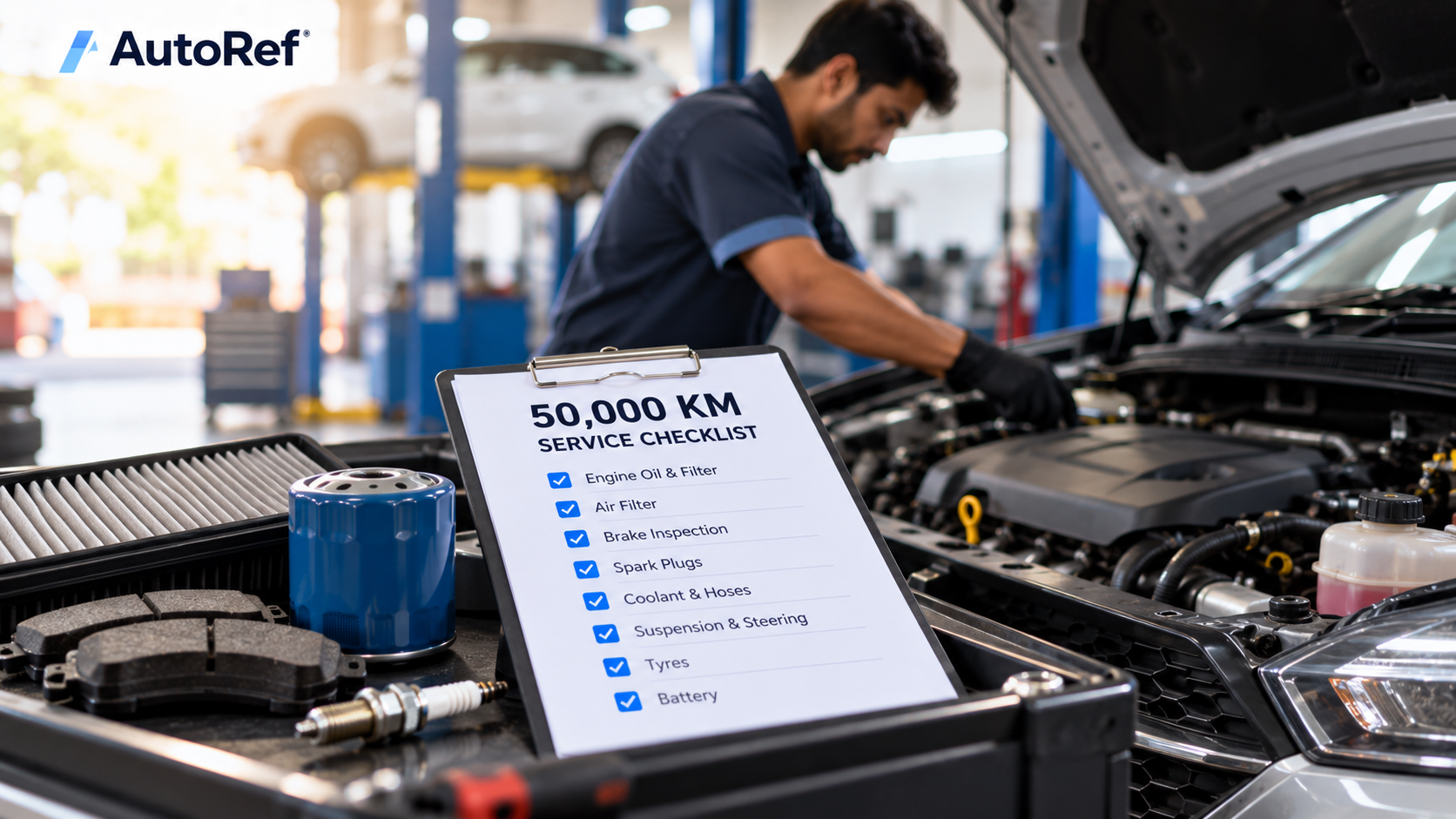
What Should Be Checked at 50,000 Km?
| Item | What to check | Why it matters |
|---|---|---|
| Engine oil & filter | Replace as per schedule | Lubrication and engine protection |
| Air filter | Inspect/replace | Prevents restricted airflow and poor efficiency |
| Cabin/AC filter | Inspect/replace | Airflow and cabin air quality |
| Brake pads & discs | Measure actual wear | Braking performance |
| Brake fluid | Check condition and schedule | Hydraulic braking performance |
| Coolant | Level, condition and schedule | Engine temperature control |
| Tyres | Tread, cracks, uneven wear | Safety and grip |
| Battery | Health and charging | Starting reliability |
| Suspension | Bushes, shocks, links | Ride, stability and tyre wear |
| Belts & hoses | Cracks, looseness, leakage | Prevents breakdowns |
| Wheel alignment | Check if symptoms exist | Steering and tyre wear |
| Transmission | Fluid/leak/operation | Smooth gear changes |
Some components that commonly wear around this mileage are brake pads, tyres, suspension bushes, wiper blades, clutch components and batteries. But mileage alone is not enough to justify replacement.
For example, replacing brake pads because the car has crossed 50,000 km is different from replacing them because the measured friction material is below the manufacturer's limit.
Petrol, Diesel and CNG: What Is Different?
Petrol
Pay particular attention to:
- Engine oil and oil filter
- Air filter
- Spark plugs according to the manufacturer's interval
- Brake system
- Coolant and hoses
- Battery
- Suspension and tyres
Maruti's maintenance guidance, for example, specifies air-filter cleaning/replacement intervals that differ by fuel type and road conditions.
Diesel
A diesel car deserves additional attention to:
- - Air filter
- - Fuel filter
- - Engine oil and oil filter
- - Turbo and intake system for leakage
- - Injector performance if symptoms exist
- - Battery
- - Clutch
- - DPF/EGR-related systems on applicable vehicles
Do not approve injector cleaning, DPF cleaning or other expensive work simply because the odometer shows 50,000 km. There should be a diagnostic reason.
CNG
- For CNG vehicles, check:
- - Spark plugs and ignition performance
- - CNG system components according to the manufacturer's schedule
- - Filters where applicable
- - Engine oil
- - Air filter
- - Cooling system
- - Valves/hoses/connections as prescribed
- - Petrol-system operation
Maruti currently sells CNG variants across several models and provides separate owner manuals for CNG vehicles, so the exact maintenance requirements should be checked against the specific model and variant.
What Can Be Oversold at 50,000 Km?
This is where owners should slow down before approving the bill.
Common recommendations that deserve evidence before approval include:
- - Engine flushing
- - Injector cleaning
- - Throttle-body cleaning
- - AC disinfecting or deep cleaning
- - Coolant replacement when the schedule does not require it
- - Gearbox oil replacement without checking the manufacturer's interval
- - Brake-pad replacement without showing remaining thickness
- - Wheel alignment and balancing without a reason or measurement
- - Battery replacement when a health test shows it is still good
- - Suspension replacement when only a minor bush or link is worn
- - Premature clutch replacement based only on mileage
These services are not inherently unnecessary. The question is why the vehicle needs them now.
How Much Does a 50,000 Km Service Cost?
The cost varies substantially by model, fuel type, city, workshop and additional repairs.
As a practical planning range, a routine 50,000 km service can look approximately like this:
| City | Routine service | With wear/repair items |
|---|---|---|
| Tier 1 | ₹6,000–₹10,000 | ₹12,000–₹25,000+ |
| Tier 2 | ₹5,000–₹8,000 | ₹10,000–₹20,000+ |
| Tier 3 | ₹4,000–₹7,000 | ₹8,000–₹16,000+ |
These are indicative ranges, not manufacturer prices. Published estimates for individual Maruti models show 50,000 km scheduled services around ₹5,000-₹6,000 in several cases, while actual costs rise when wear items or additional repairs or cosmetic items are added.
The important distinction is between the scheduled service bill and the repair bill.
Before You Approve the 50,000 Km Bill
Ask the workshop to separate:
- 1. Scheduled service items
- 2. Parts that have actually worn out
- 3. Recommended but non-urgent work
- 4. Diagnostic observations
- 5. Optional cleaning or convenience services
This makes it much easier to understand whether a ₹7,000 service has genuinely become a ₹18,000 repair bill.
For individual owners and small fleets, keeping previous invoices also helps. A part replaced at 40,000 km should not automatically appear again at 50,000 km without an explanation.
How AutoRef Can Help at 50,000 Km
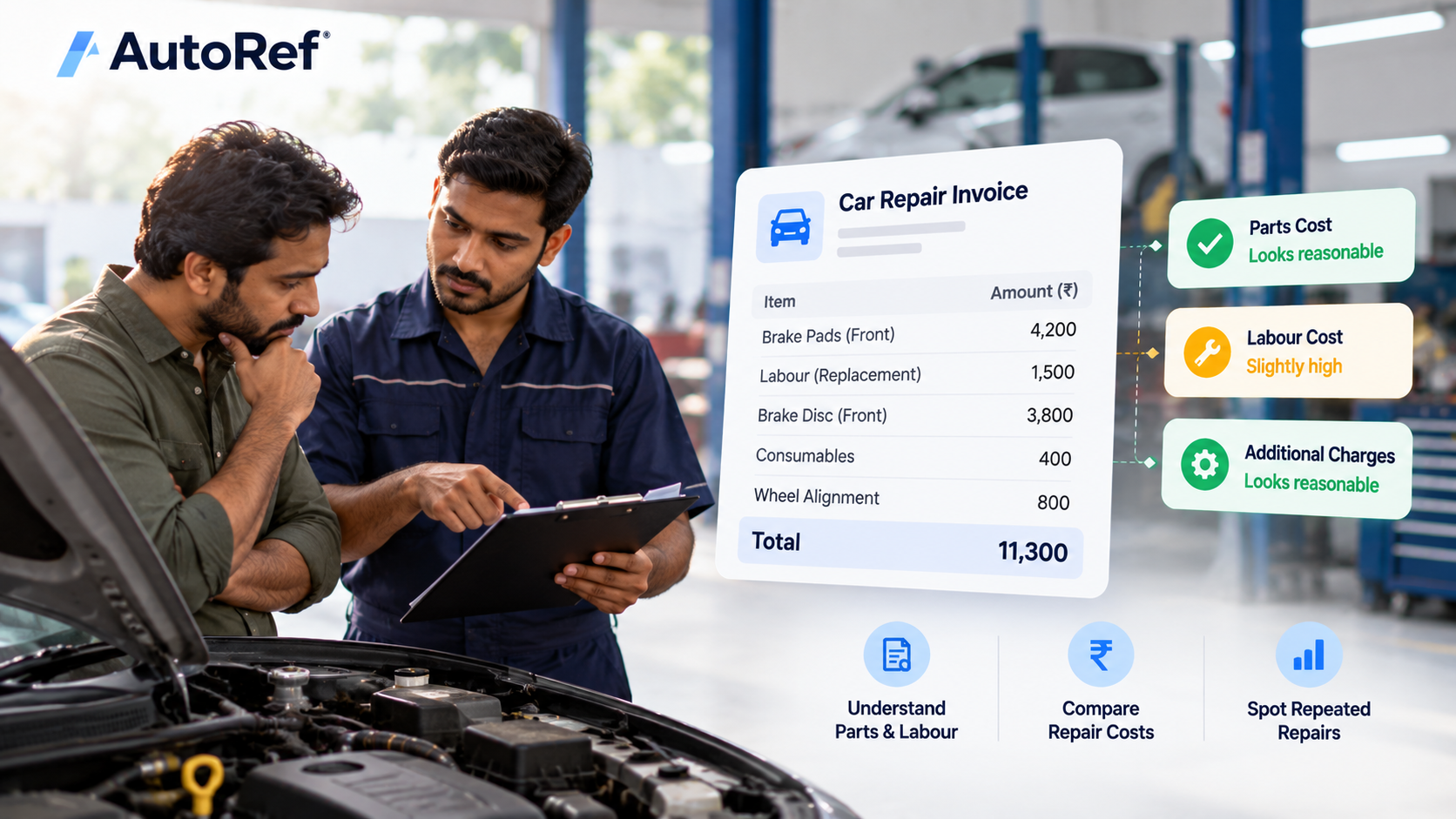
At the 50,000 km service, AutoRef combines your vehicle's historical service data with invoice analysis to give you better context before approving additional work. Previous service records help you see which parts or repairs were already carried out, while uploading the current service invoice allows AutoRef to analyse the listed parts, labour and additional charges and flag items that may need confirmation or justification. This is particularly useful when a workshop recommends multiple replacements at once, because you can compare the recommendation with what was actually done during earlier services instead of relying only on the current invoice.
Conclusion
A 50,000 km car service checklist should be treated as a decision point, not a shopping list. Oil, filters, brakes, tyres, suspension, battery, cooling system and other components should be inspected according to the vehicle's actual condition and manufacturer schedule.
For petrol, diesel and CNG vehicles, some checks differ because their fuel and engine systems have different maintenance requirements.
The biggest protection against unnecessary spending is simple: check the service history, ask why each replacement is required, and separate scheduled maintenance from additional repairs.
Frequently Asked Questions
Can AutoRef track my 50,000 km service history?
Yes. AutoRef keeps service and repair information against the vehicle so you can refer to previous work when the next service is due.
Can AutoRef help me review a 50,000 km service invoice?
Yes. You can upload the service invoice and use AutoRef to analyse the listed parts, labour and additional charges.
Can AutoRef help identify repeated repairs?
Your vehicle's previous service records can be reviewed alongside the latest invoice, making it easier to identify parts or work that appear repeatedly.
Can I use AutoRef for multiple cars?
Yes. AutoRef is designed to maintain vehicle-level maintenance records, making it useful for individual owners as well as small fleets.
Does AutoRef tell me that a service charge is unnecessary?
AutoRef can flag invoice items that require confirmation or justification based on the available vehicle and service context. A flagged item is not automatically proof that the charge is wrong.
Related Articles
All Car Maintenance & Upkeep → Car Maintenance & Upkeep
Commercial Vehicle Permit: How to Check Validity and Expiry
Commercial Vehicle Permit: Check Validity & Expiry
 Car Maintenance & Upkeep
How to Check If a Car Repair Cost Is Reasonable
Learn how to check car repair costs, compare parts and labour, identify repeated repairs and evaluate repair bills for your car or fleet.
 Car Maintenance & Upkeep
Vehicle Compliance Checklist: RC, Insurance, PUC, Challans and Permits
Vehicle compliance checklist covering RC, insurance, PUC, challans and permits, with practical tips for individual owners and commercial fleets.